How to promote a pickleball facility: the Pickleland marketing playbook


The fastest way to promote a pickleball facility is to win local search, make the first visit nearly free, and turn regulars into the marketing. Paid ads come last. That is the playbook we run at Pickleland, our own club: nine climate-controlled indoor courts at 21427 Martin Lane in Pflugerville, in the Austin area, which as of October 2026 shows a 4.9-star rating from 918 Google reviews.
Pickleball marketing differs from SaaS or e-commerce marketing in one important way: the product is a place and a group of people. Almost every tactic below either gets a new player through the door once, or gives an existing player a reason to bring a friend.
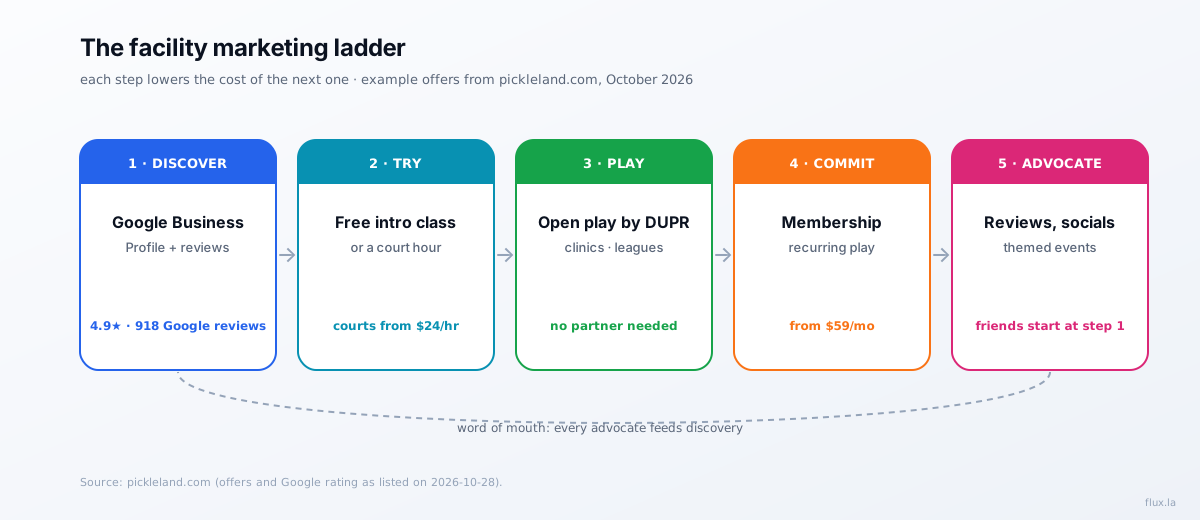
1. Win “pickleball near me” first
Most new players find a club the same way they find a restaurant: a map search on a phone. A complete Google Business Profile is the single highest-leverage marketing asset a facility has, and it costs nothing.
- Fill in everything: categories, hours (including holiday hours), booking link, photos of the courts, parking and entrance.
- Ask for reviews at the moment of delight: after a first clinic, a league night or a tournament, not in a cold email weeks later.
- Reply to every review, including the critical ones. Prospective players read the replies.
- Post updates weekly: leagues starting, tournament results, new clinics. It keeps the profile current and gives searchers a reason to choose you.
Our local SEO guide covers the map pack, citations and reviews in detail. Pickleland’s review count is the clearest result of doing this consistently.
2. Make the first visit cheap and easy
The hardest sale is the first one. Pickleland lowers it two ways: a free intro class for new players and court rental from $24 an hour for people who already play. A beginner who would never commit to a membership on day one will try a free class.
Then remove every bit of friction between interest and a booking:
- Show prices on the website. Players compare clubs on price; hiding it behind a form loses them.
- Book in a few taps on a phone. Pickleland’s courts book through play.pickleland.com and its mobile app.
- Say who each session is for. “Open play sorted by DUPR level, no partner needed” answers the two biggest fears a newcomer has: being outmatched and not having anyone to play with.
3. Let the programs do the marketing
At a pickleball club, the schedule is the content. Every recurring session is a reason for a new player to show up and for a regular to bring someone:
- Open play sorted by skill level, so newcomers have a safe place to start.
- Weekly clinics by level, from beginner up to 4.0+, which turn casual players into committed ones.
- Leagues and tournaments, which pull in players from outside your usual radius.
- Themed socials: Pickleland runs ladies’ nights, singles mixers and themed events. These bring in people who come for the event and stay for the sport.
- Junior programs, which bring in parents, who often become players themselves.
4. Turn regulars into members
Memberships smooth revenue and keep players coming back. Pickleland’s start from $59 a month. Keep pay-per-play available alongside membership: a pure membership model blocks the trial that feeds it. Show both prices clearly, and make the membership the obvious choice for anyone playing more than a few times a month.
5. Social media: show the sport, show the people
The channels worth the effort for a facility are the visual, local ones:
- Instagram and TikTok for short clips: rallies, slow-motion highlights, member spotlights and event recaps. Pew’s 2026 survey found 51% of US adults use Instagram and 37% use TikTok. Our Instagram growth playbook covers what Instagram rewards.
- Facebook groups in your area, where tournament and league announcements still travel well.
- YouTube Shorts, using the same clips, for a longer shelf life.
LinkedIn and X are rarely worth a facility’s time, except for corporate events.
6. Email and SMS for the people you already know
Every sign-up, clinic intake and tournament registration is a chance to collect an email address and phone number with consent. A weekly email with upcoming events and day-of text reminders reach people who have already played with you, which makes them the most likely to come back.
7. Local press, with a real angle
“New pickleball facility opens” is no longer news in most towns. Stories that still get covered: an unusual founder story, a charity tournament, a free clinic for a specific community, a junior program or a big local event. Pitch the community or lifestyle reporter rather than the business desk. Our guide to digital PR explains how to package a pitch.
What to measure
Track a short list monthly:
- Google Business Profile calls, direction requests and website clicks.
- New-player bookings, especially free intro classes and first court rentals.
- Conversion from first visit to second visit and to membership.
- Member retention. Keeping a member is cheaper than finding a new one.
- New reviews per month and the average rating.
If you run a facility and want a second pair of eyes on your marketing, tell us what you’re working on. We are based in Austin and run the same playbook at our own club; see our Austin marketing agency page.
FAQ
How do I market a new pickleball facility? Start with a complete Google Business Profile and a review habit, offer a free or very cheap first visit, publish clear prices and easy online booking, and build recurring programs (open play by level, clinics, leagues and socials) that give players reasons to return and bring friends.
What is the best marketing channel for a pickleball club? Local search. Most new players find a club through a “pickleball near me” search on a phone, which is why a strong Google Business Profile and steady reviews matter more than any ad budget in the first year.
Should a pickleball facility offer memberships or pay-per-play? Both. Pay-per-play and free intro classes keep the door open for new players; memberships reward regulars. Pickleland pairs a free intro class and courts from $24 an hour with memberships from $59 a month.
Related reading:
- Local SEO in 2026: the map pack, reviews and citations
- How to grow on Instagram in 2026
- Social media usage statistics 2026
Sources: pickleland.com (location, courts, programs, prices and Google rating, as listed on October 28, 2026); Pew Research Center, Social Media Fact Sheet (2026 data).
One copyable AI agent, every Wednesday.
Flux founder Alejandro Rioja's weekly newsletter for operators: an agent he shipped that week, one growth experiment with real numbers, and what's working across SEO and GEO right now.
Free · 1-click unsubscribe · confirm by email and you're in.
Alejandro Rioja
Operator who builds and sells marketing-focused brands. Founder of Pickleland, founder of Flux.LA, writing about AI SEO + GEO at alejandrorioja.com.