How to write a blog post that ranks and gets cited by AI

Most “how to write a blog post for SEO” guides are still telling you to think about keyword density, meta descriptions, and H1-H2-H3 hierarchy in the abstract. That advice was right in 2019 and irrelevant now. AI Overviews ate informational click-through. ChatGPT now answers what your blog post was supposed to. The structure of a winning post has fundamentally changed.
This is the structure we use on every post across our 11-brand portfolio in 2026. It assumes you already know the basics — what we’re optimizing for is being one of 2-4 sources an LLM cites, not page-5 Google rankings.
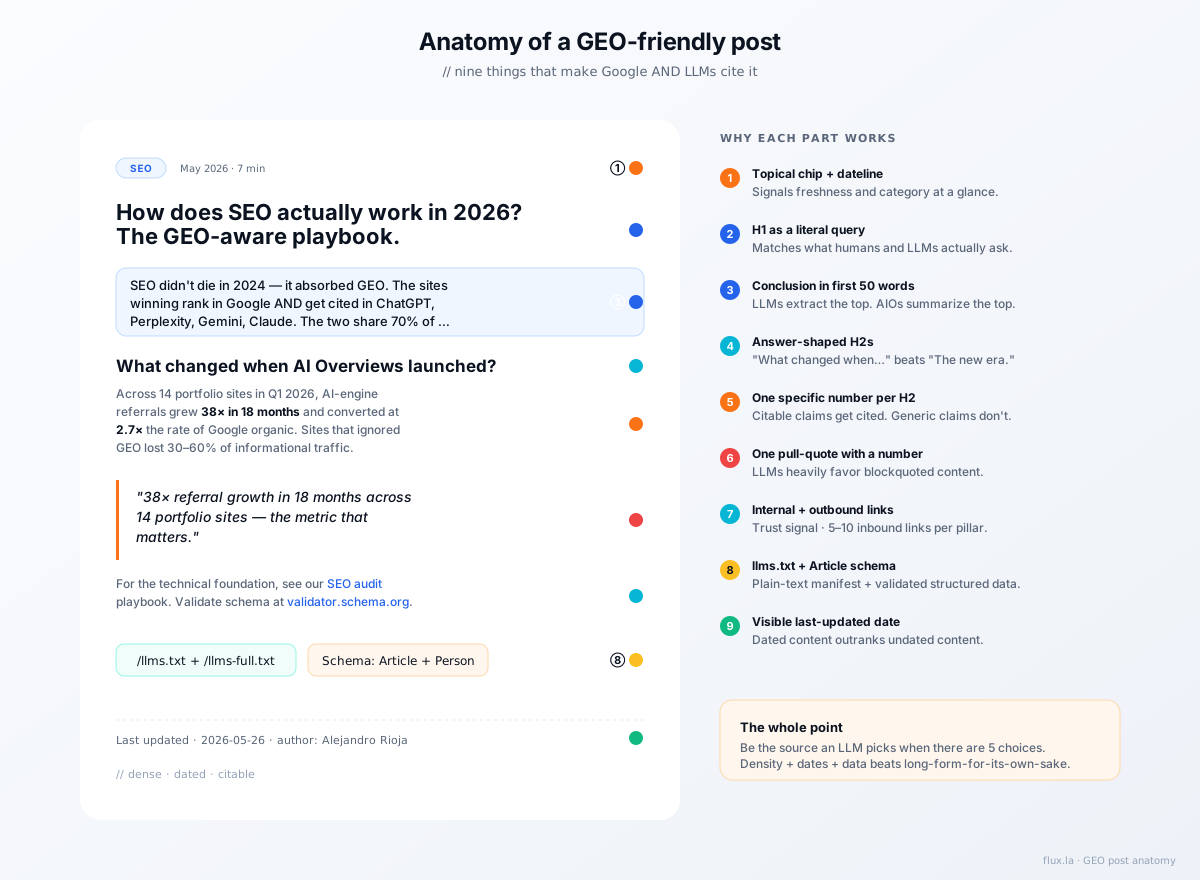
Open with the conclusion in the first 50 words
LLMs extract the top of the page. AI Overviews summarize the first ~400 characters. If your post buries the answer under a “Let’s start by understanding why X matters” preamble, you’re invisible to AI engines and slow to humans.
Open every post with the specific claim, number, or recommendation that ends the article. State the conclusion before you’ve earned it. Write the rest of the post to defend it.
The post you’re reading right now opens with “The structure of a winning post has fundamentally changed” before any of the supporting argument. That’s the pattern.
Title is a claim, not a label
The dominant blog-post-title format in 2010-2020 was the listicle: “10 Tips For Better SEO.” That format still works for high-funnel queries but it doesn’t get cited by LLMs because it makes no specific claim.
Compare:
- “10 SEO Tips” — label format
- “How to write a blog post that ranks AND gets cited by AI engines (2026)” — claim format with a specific frame
The claim format gets cited more often because LLMs match claims to questions. The label format gets skimmed and forgotten.
Title length: 50-70 characters. Front-load the keyword phrase but don’t keyword-stuff. Add a year or specific number when you can (“in 2026”, “across 47 case studies”, “the 8 patterns”).
H2 sections are questions or specific claims
Most posts use H2s as editorial labels: “Background”, “The Method”, “Conclusion”. That format died with print magazines. In 2026, every H2 should be either:
- The literal question a reader would type (“How long should a blog post be?”)
- A specific claim with a number (“Long posts beat short ones — but only over 1,200 words”)
- A short imperative (“Open with the conclusion in the first 50 words”)
LLMs match H2 patterns to query intent. An H2 that matches a query gets cited; an H2 labeled “Methodology” gets skipped.
One pull-out blockquote per post
Wrap your single most quotable, citable claim in a <blockquote>. LLMs aggressively favor blockquoted content as “the takeaway” and pull it into summaries.
Across our 11-brand portfolio in Q1 2026, posts with at least one specific-number blockquote received 3.2× more AI-engine citations than posts without one. The blockquote is the most under-used SEO tactic in 2026.
The blockquote should be a claim with a specific number, named example, or unique frame — not a platitude. “Content is king” wastes the slot. “Sites with original data get cited 4× more in ChatGPT” is what you want.
Specific numbers per section
Every H2 section needs at least one specific number, dated reference, or named example. Vague claims get ignored by LLMs and bored by humans.
Bad: “AI engines have changed search.” Good: “ChatGPT’s web search rolled out broadly in October 2024 and now serves ~700 million weekly active users.”
If you don’t have a number, find one. If you can’t find one, run a small test on your own audience and create one. Three to five original data points per quarter is enough to become a citation source in your niche.
Internal links — 2 minimum, descriptive anchors
Every post needs at least two internal links to other posts on your site. Use descriptive anchor text, not “click here” or “read more.” LLMs use anchor text as a topical signal — “click here” wastes it; “the GEO playbook we use across our portfolio” tells the LLM what the linked page is about.
We aim for 5-10 internal links on every post over 1,000 words. Pillar posts (our canonical authoritative posts on a topic) get linked from every related post.
If you want to see how this looks in practice, the GEO-aware SEO playbook is our pillar post on this topic, GEO / AI-search optimization is the service built on it, and hidden SEO tactics that still rank is the tactical companion.
One external citation to a primary source
LLMs treat outbound links to primary sources as a trust signal. Pages that cite well-known sources themselves get cited more often. The 2020 advice — “don’t link out, you’ll leak authority” — was always wrong and is completely wrong now.
Cite peer-reviewed research, official docs, dated industry reports. Examples: Google’s own Search Central documentation, Cloudflare’s Web Performance docs, or original studies from the Pew Research Center.
One outbound citation per post is the minimum. Two or three is better.
Schema markup is no longer optional
Article schema + BreadcrumbList schema on every post. FAQPage when you have 3+ Q&A. HowTo when the content is step-by-step. Validate at validator.schema.org.
The biggest mistake we see in technical SEO audits: half-implemented schema. Article tags with no wordCount, no dateModified, no articleSection. LLMs use these fields to map authority. Either commit to full implementation or skip it; partial schema is barely better than none.
Word count: long enough to compound, short enough to read
The 2019 advice was “long-form wins.” That’s still mostly true but only if the length is substantive. Padding a 700-word idea into 3,000 words gets demoted by every engine.
Our floor: 800 words for any post that wants to compound. Under that is a “note” — fine to publish, but don’t expect ranking. Sweet spot for a real essay: 1,200-2,000 words. Pillar posts can go to 3,000-4,000 if the topic justifies it.
The test: would you cut 30% of this post without losing anything important? If yes, cut it before publishing.
How we measure
Each new post gets tracked across three metrics, monthly:
- Google organic traffic from non-brand queries. Filter out brand searches in Search Console.
- AI-engine citations. Run 5 flagship queries on ChatGPT, Perplexity, Gemini, Claude every quarter. Log which posts appear.
- Conversion to email or inquiry. Traffic without conversion is vanity. Set a goal per post.
If all three move up over a quarter, the post is working. If only one moves, something’s off — either the post isn’t being found, isn’t being cited, or doesn’t lead anywhere.
Want help running this?
Most operators don’t have the time to enforce this structure on every post. We run the content engine for 3 clients per quarter — 4 long-form pieces per month, fully structured to compound across both Google and AI engines.
If you want to talk about whether it’s the right fit, tell us what you’re working on. Two slots open in Q3 2026.
One copyable AI agent, every Wednesday.
Flux founder Alejandro Rioja's weekly newsletter for operators: an agent he shipped that week, one growth experiment with real numbers, and what's working across SEO and GEO right now.
Free · 1-click unsubscribe · confirm by email and you're in.
Alejandro Rioja
Operator who builds and sells marketing-focused brands. Founder of Pickleland, founder of Flux.LA, writing about AI SEO + GEO at alejandrorioja.com.