Market segmentation in 2026: who AI changed, who it didn't

Most “market segmentation 101” content is still teaching the 2020 model: demographic, geographic, behavioral, psychographic. That model is fine, but it’s missing the biggest shift of the last two years — AI agents are now buying on behalf of humans for a meaningful share of high-consideration purchases, and they segment differently than humans do.
This is the framework we use across our 11-brand portfolio to think about who we’re selling to in 2026.
The four classic segments still mostly work
For the record, the textbook segments are:
- Demographic — age, income, family status, education
- Geographic — country, region, urban vs. rural, climate
- Behavioral — purchase frequency, brand loyalty, usage occasion
- Psychographic — values, attitudes, lifestyle, interests
These aren’t broken. We still use them. The shift is that two of them (behavioral and psychographic) are now partly observed by AI systems instead of inferred from surveys, and one new dimension matters more than before.
The new dimension: AI agency
The question that didn’t exist in 2020: does an AI agent stand between you and the decision-maker?
For some categories, yes increasingly:
- Software procurement (an AI screening tool may filter vendor lists before a human sees them)
- Travel booking (ChatGPT, Perplexity, and Google’s Shopping AI shortlist hotels)
- Commodity eCommerce purchases (Amazon Rufus, ChatGPT Shopping)
- Investment screening (Bloomberg’s GPT-powered terminal, retail apps with AI assistants)
For others, mostly no:
- High-ticket B2B services (humans still want to talk to humans before signing $50K+ contracts)
- Healthcare decisions (still doctor-mediated)
- Real estate (still human-mediated)
- Most luxury goods (the brand experience IS the purchase)
The single most important segmentation question in 2026: which percentage of your buyers reach the purchase decision through an AI intermediary? Treat that as its own segment — they need different marketing than humans-only buyers do.
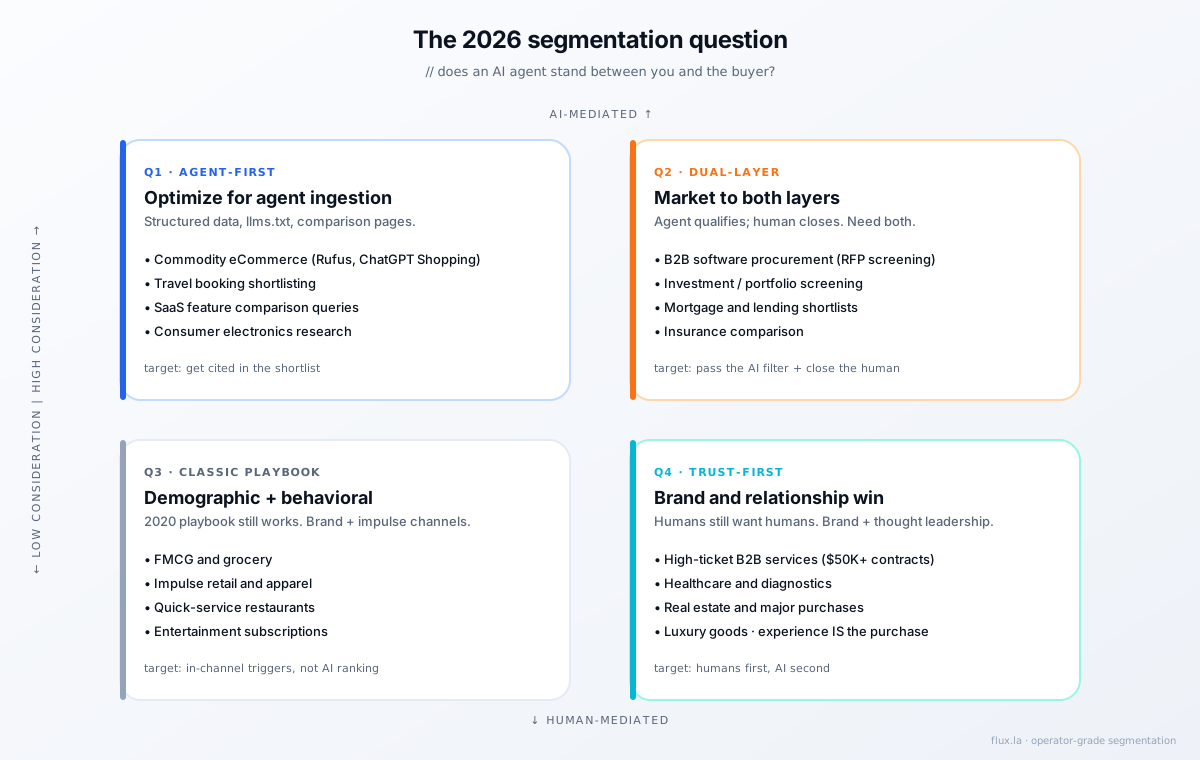
Segmenting for AI agents vs. humans
When an AI agent is involved, your marketing has to serve two audiences:
The human user, who needs: trust signals, brand familiarity, social proof. The AI agent, which needs: structured data, dated facts, specific specs, citation-friendly content.
These overlap more than they conflict. A product page with thorough specs, dated reviews, and schema markup serves both audiences. But there are places they diverge:
- Humans respond to lifestyle imagery; AI agents need alt text descriptions of what’s in the image
- Humans accept marketing copy like “premium materials”; AI agents need the actual material specified
- Humans browse around a category page; AI agents grab the single most cite-able product page
For the AI-mediated segment, we audit specifically: can an AI agent find your offering, parse the relevant attributes, and recommend it confidently to a human? About 40% of eCommerce sites we audit fail this test in 2026.
Behavioral segmentation got easier and harder
Easier: data tools that didn’t exist five years ago. Heap, PostHog, Mixpanel — all auto-capture detailed behavioral events without manual instrumentation. You can segment users by literal action paths through your product, not just inferred attitudes.
Harder: third-party cookies are effectively dead. iOS 17 raised the bar again. Facebook attribution is a shadow of what it was. The behavioral data you have is now mostly first-party — your own analytics, your own email list, your own purchase records.
The practical implication: invest in your first-party data infrastructure. We see most small-team marketing operations still over-reliant on Google Analytics 4 (which has its own attribution issues post-iOS 17). The teams winning have a customer data store they own — could be as simple as a Postgres database fed by their checkout and onboarding events.
Psychographic segmentation: still useful, easier to validate
The 2010s critique of psychographic segmentation was that it was unfalsifiable — you’d describe your customer as “values authenticity and craftsmanship” and have no way to verify it.
In 2026, that’s less true. You can pull psychographic signals from:
- Email open and click patterns (do they engage with thought-leadership content or product-news content?)
- Social signals (what accounts do they follow, what content do they engage with)
- Public LLM behavior (the queries they ask ChatGPT/Perplexity about your category — surveyable through tools like SparkToro or Quantcast)
Psychographic segments are now testable: build a hypothesis, build the campaign, watch the engagement difference. If “the craftsmanship-valuing segment” responds to your craftsmanship-themed campaign 3× more than to your performance-themed campaign, the segment is real.
A working segmentation for a small brand
If you’re running a small B2B SaaS or D2C brand and you have limited time, the segmentation we recommend most often is:
- Job/role + company size (demographic) — what they do, who they work for
- Stage of buying journey (behavioral) — first visit, second visit, has-pricing-page-views, has-trial
- AI-mediated or not (the new dimension) — do they reach you through ChatGPT/Perplexity recommendations, or direct/Google search?
Three segments × three stages = 9 cells you target. That’s enough granularity to do real marketing without drowning in spreadsheets.
Where segmentation breaks
Honest list of segmentation traps we see repeatedly:
Segmenting by what you wish were true. A segment you can’t measure isn’t a segment.
Too many segments. If you have 27 personas, you have zero personas. Most small teams should have 3-5.
Segments that don’t get treated differently. If “enterprise” and “SMB” both get the same email sequence, they’re not really segmented.
Static segments. People change. Behavioral and stage-of-journey segments need to be dynamic — recompute weekly.
What we do for clients
When we run a positioning or brand engagement (the $8K Brand Sprint), the segmentation is the first three days of work. We narrow to 3-5 segments, validate each against existing customer data, and tie each one to a specific message and offer.
If you want help working out who you’re actually selling to, tell us what you’re working on.
Related reading:
- How SEO actually works in 2026 — adjacent: how AI agents read your content
- eCommerce UX in 2026 — adjacent: how AI shopping agents segment buyers
One copyable AI agent, every Wednesday.
Flux founder Alejandro Rioja's weekly newsletter for operators: an agent he shipped that week, one growth experiment with real numbers, and what's working across SEO and GEO right now.
Free · 1-click unsubscribe · confirm by email and you're in.
Alejandro Rioja
Operator who builds and sells marketing-focused brands. Founder of Pickleland, founder of Flux.LA, writing about AI SEO + GEO at alejandrorioja.com.