How to grow on Instagram in 2026 (the post-TikTok playbook)


To grow on Instagram in 2026, make Reels that people watch to the end and send to someone, post original work rather than reposts, and keep a steady cadence. That is not a hunch about “the algorithm.” It is close to what Instagram itself says it ranks: for Reels, its own ranking explainer lists the most important predictions as how likely you are to “reshare a reel, watch a reel all the way through, like it.” Hashtag strategies, follow-for-follow and engagement pods target none of those.
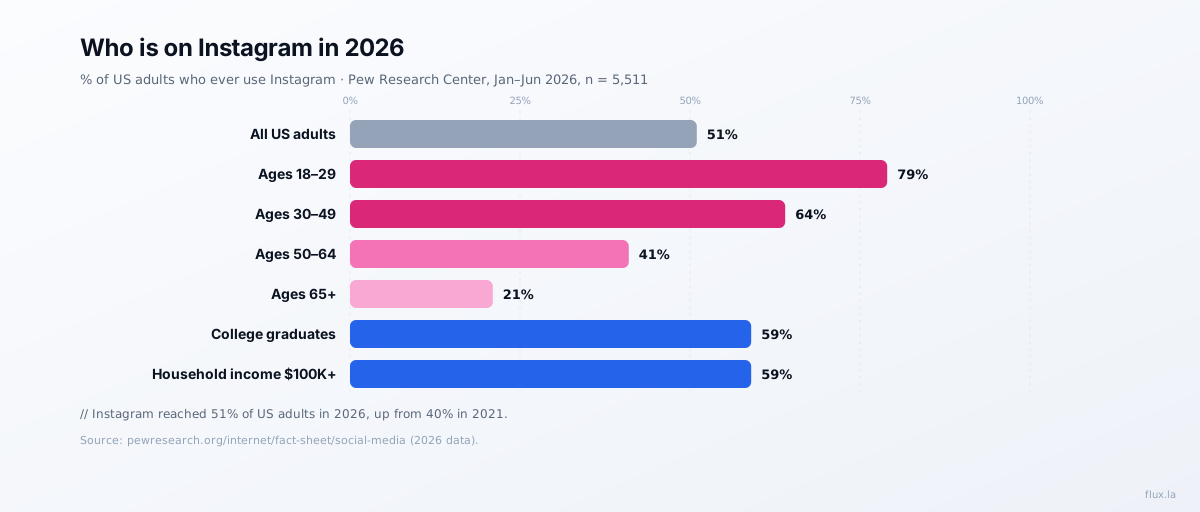
The audience is worth the effort. According to Pew Research Center’s 2026 survey, 51% of US adults use Instagram, up from 40% in 2021, including 79% of adults under 30 and 59% of college graduates. Here is the playbook we use, for personal brands, consumer brands and B2B accounts.
What Instagram says it ranks
Instagram does not use one algorithm. Feed, Stories, Explore and Reels each rank content differently, and Instagram has published the main inputs for each. The two surfaces that bring in new followers are Reels and Explore, because they show content from accounts people do not follow yet.
| Surface | What Instagram says matters most | What that means for you |
|---|---|---|
| Reels | Likelihood the viewer will reshare it, watch it all the way through and like it | Short, complete, worth sending. Watch-through beats length. |
| Explore | Likelihood of a like, save or share, plus how popular the post is and the viewer’s past interests | Saves and shares on posts in a clear niche, so Instagram knows who they’re for |
| Feed | Your activity, information about the post and its author, and your history with the account | Serves existing followers. Good for retention, weak for growth. |
| Stories | Viewing history, engagement history and closeness to the account | Deepens relationships with people already following you. |
The same explainer is explicit about what gets less distribution in Reels: low-resolution video, watermarks (including another app’s logo), muted audio, borders, mostly-text Reels, and Reels “that have already been posted on Instagram.” In other words, re-uploading your TikToks with the watermark, or reposting someone else’s clip, works against you by design.
What no longer works (skip these)
- Hashtag strategies. Use a few accurate hashtags if you like, but they are not how Reels are distributed. The ranking inputs above are about viewer behavior, not tags.
- Follow-for-follow and engagement pods. They produce followers who never watch, which drags down exactly the watch-through and share signals that matter.
- Buying followers. Fake followers do not watch or share either, so you pay to make your engagement rate look worse, and Instagram’s rules prohibit inauthentic activity.
- Cross-posting TikToks unedited. Watermarked clips are named in Instagram’s own list of content it shows less. Export a clean file.
The playbook
1. Hook, then pay off. The first two seconds decide whether someone keeps watching, and watching to the end is a top ranking prediction. Lead with the claim, the result or the question, then deliver it in 15 to 45 seconds.
2. Make it worth sending. A reshare to a friend is one of the actions Instagram says it predicts for Reels. “Send this to the person who…” content, checklists and specific, useful tips get sent; generic motivation does not.
3. Post original work. Film it yourself, use your own voice or original audio, and avoid reposting other accounts’ clips. Originality is the difference between the content Instagram promotes and the content it says it shows less.
4. Use carousels for anything with steps. For multi-step or text-heavy ideas, carousel posts collect saves, which matter in Explore. Not everything has to be a Reel.
5. Reply to comments with Reels. Turning a good question in your comments into a short answer Reel gives you an idea with proven demand and a natural reason for the commenter to share it.
6. Repurpose long-form video. One recorded conversation or YouTube video can become several short clips. It is the highest-leverage workflow we know for a small team; our content repurposing system shows the steps.
7. Keep a cadence you can sustain. A few good Reels every week, consistently, beat a burst of daily posting that stops after a month. Treat 90 days as the minimum test window before judging a strategy.
Instagram for B2B is real
Instagram is not only for consumer brands. Linear (@linear), Notion (@notion) and Figma (@figma) all run active accounts built on product craft, workflows and community. They treat Instagram as top-of-funnel category education, not lead generation, and let conversion happen later through retargeting, email or LinkedIn.
The Pew data supports the move for some B2B companies: 59% of college graduates and 59% of adults in $100,000-plus households use Instagram, more than use LinkedIn (51% and 45%). Instagram does not tell you who is a buyer the way LinkedIn does, but the people are there. We compare all the major platforms in social media usage statistics for 2026.
How to measure whether it is working
Follower count lags. Track these instead, every two weeks:
- Average watch time and completion rate on Reels, from Instagram’s insights.
- Shares and saves per 1,000 accounts reached, which map to the actions Instagram says it predicts.
- Share of reach from non-followers, which tells you whether Reels and Explore are distributing you to new people.
- Profile visits and link taps, the step between a view and a follow or a lead.
If all four are flat after 90 days of consistent posting, the problem is the content, not the cadence. If you want help building that content engine, tell us what you’re working on.
Related reading:
- Social media usage statistics 2026: which platforms reach which audiences
- Top 8 content marketing campaigns: examples that worked across formats
- TikTok for B2B marketing: the adjacent short-video play
Sources: Instagram, “Instagram Ranking Explained” (May 31, 2023); Pew Research Center, Social Media Fact Sheet (2026 data).
One copyable AI agent, every Wednesday.
Flux founder Alejandro Rioja's weekly newsletter for operators: an agent he shipped that week, one growth experiment with real numbers, and what's working across SEO and GEO right now.
Free · 1-click unsubscribe · confirm by email and you're in.
Alejandro Rioja
Operator who builds and sells marketing-focused brands. Founder of Pickleland, founder of Flux.LA, writing about AI SEO + GEO at alejandrorioja.com.