How much does press release distribution cost in 2026? Prices compared

Distributing one press release costs anywhere from $29 to about $1,000 in 2026, depending on the wire and how far you want it to travel. We checked the public pricing pages of the services that publish their rates on October 28, 2026: 24-7 Press Release lists tiers from $29 to $479, PRWeb from $120 to $480, EIN Presswire charges $149 for a single release, and Newswire’s national plans run $399 to $965. PR Newswire does not publish a list price; third-party guides estimate roughly $850 to $1,070 for a 400-word US national release, plus a $195 annual membership.
The more important question is what the money buys, because a wire release does not buy coverage. It buys syndication: your text republished on partner sites, plus a place in journalists’ feeds.
Press release distribution prices, side by side
| Service | Published price per release | What the tiers add | Source |
|---|---|---|---|
| 24-7 Press Release | $29, $49, $89, $139, $199, $479 | Six tiers from a simple post to “Mass Media Visibility” | pricing page |
| EIN Presswire | $149 (1 release); $499 for 5 + 1; $999 for 15 | All tiers list AP News, the USA TODAY Network and Nexstar distribution “based on relevance” | pricing page |
| PRWeb | $120, $245, $360, $480 | Higher tiers add syndication through PR Newswire’s network, a journalist email list and proofreading | pricing page |
| Newswire | $399, $659, $965 (national); $599 (one state) | Estimated reach from 6–10M up to 150–200M monthly readers, per Newswire | pricing page |
| PR Newswire | Not published; ≈ $850–$1,070 national + $195 membership (third-party estimates) | Circuit, word count, images and logo all priced separately | NewswireJet, Prezly |
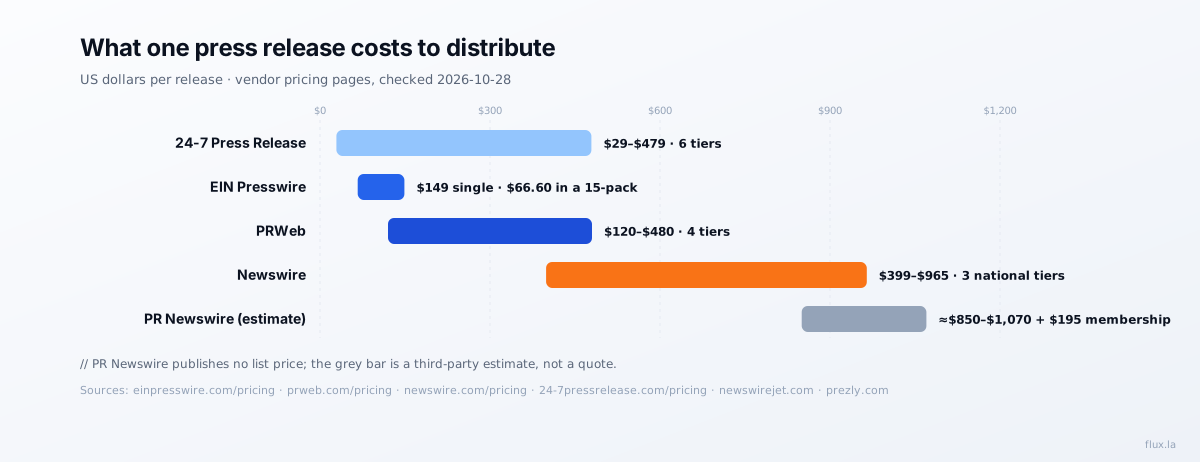
Bundles change the math. EIN Presswire’s 15-release Corporate package works out to $66.60 per release, less than half its single-release price. If you announce something every month, price the annual volume, not the first release.
What you are actually paying for
Every tier, cheap or expensive, sells the same three things in different amounts:
- Syndication. Your release republished verbatim on partner sites (local TV station sites, finance portals, news aggregators). This is what produces the “as seen on” logos in a wire’s report.
- Feeds and databases. Placement in the newsrooms, terminals and monitoring tools journalists use, which is where the premium wires earn their price.
- Targeting. State, industry or national circuits, and sometimes a journalist email list.
What none of them sells is an article. Syndicated copies are your words on someone else’s domain, not a story a reporter chose to write. That is the core distinction we draw in how much PR costs: distribution is a cost line, coverage is an outcome.
Do press release links help SEO?
Not in the way most packages imply. EIN Presswire’s tiers, for example, advertise “3 keyword anchor text links.” Google’s spam policies list “links with optimized anchor text in articles, guest posts, or press releases distributed on other sites” as an example of link spam. A wire release with keyword-rich links pointing at your money pages is the textbook case.
The safe approach:
- Link to your own release or newsroom page with your brand name or a plain URL, not a keyword.
- Expect syndicated copies to carry little or no ranking value. They are duplicate text across many sites.
- Use the release as a source document. A fact-rich release on your own site is something journalists, partners and AI engines can quote. We cover whether that moves AI citations in our guide to getting featured.
When a paid wire release is worth it
- Regulated or market-moving news. Public companies have disclosure obligations, and the established wires are built for them.
- Funding, acquisitions and executive hires that trade and local press monitor wire feeds for.
- Local news. A state circuit is a cheap way to reach regional outlets that still run business briefs.
It is rarely worth it for product updates, content launches or “we published a report” announcements. For those, a short, personal pitch to the five reporters who cover your space will beat a $965 national circuit. Our HARO alternatives guide lists where those reporters ask for sources, and how to measure PR results covers what to count instead of syndication pickups.
If you want the outreach done for you, that is our PR and earned media service, a $5,000-a-month retainer built around pitching, not wire distribution.
FAQ
How much does it cost to send out a press release? Published per-release prices in October 2026 ranged from $29 (24-7 Press Release’s lowest tier) to $965 (Newswire’s top national plan). PR Newswire is quote-based; third-party guides estimate about $850 to $1,070 for a 400-word US national release, plus a $195 membership.
What is the cheapest press release distribution service? Of the services that publish prices, 24-7 Press Release has the lowest entry tier at $29. In bundles, EIN Presswire’s 15-release package works out to $66.60 per release.
Does PR Newswire publish its prices? No. Pricing depends on circuit, word count and add-ons, and you need a quote. Third-party estimates put a 400-word national release at roughly $850 to $1,070.
Are press release backlinks good for SEO? Links with optimized anchor text in distributed press releases are listed as link spam in Google’s spam policies. Use branded or plain-URL links and treat syndication as visibility, not link building.
Related reading:
- How much does PR cost?: contributor bylines to agency retainers
- Digital PR for SEO: the formats that earn real coverage and links
- How to measure PR results
Sources: pricing pages of 24-7 Press Release, EIN Presswire, PRWeb and Newswire, checked October 28, 2026; PR Newswire estimates from NewswireJet and Prezly; Google Search spam policies.
One copyable AI agent, every Wednesday.
Flux founder Alejandro Rioja's weekly newsletter for operators: an agent he shipped that week, one growth experiment with real numbers, and what's working across SEO and GEO right now.
Free · 1-click unsubscribe · confirm by email and you're in.
Alejandro Rioja
Operator who builds and sells marketing-focused brands. Founder of Pickleland, founder of Flux.LA, writing about AI SEO + GEO at alejandrorioja.com.