How to build marketing AI agents that actually ship work


If you can write a clear standard operating procedure, you can build a marketing AI agent. The hard part was never the model — it’s wiring the model to your tools, giving it the right context, and putting guardrails on the actions that matter. This is the architecture we use, stripped of jargon, so you can build your first real agent this week instead of paying for a black box.
We covered what agents do in AI agents for marketing teams. This is how to build one.
The anatomy of a working agent
Every functional agent has four parts. Get all four right and it works; skip one and it fails in a predictable way.
The goal. A single, testable objective. “Draft a weekly performance recap” — not “improve our marketing.” Vague goals produce vague loops that never terminate.
The context. What the agent knows before it starts: your brand voice, your structural rules, where the data lives, what good output looks like. This is the part most people underinvest in. The model is a smart contractor with amnesia — every run, you re-hand it the brief.
The tools. The verbs the agent can use: read the analytics API, search the web, query the CMS, draft an email, post a comment. An agent with no tools is a chatbot. An agent with the right three tools is an employee.
The loop and the stop condition. The agent acts, observes the result, decides the next step, and repeats until the goal is met or a limit is hit. Always set a hard cap — max steps, max spend, max time — so a confused agent fails small instead of running forever.
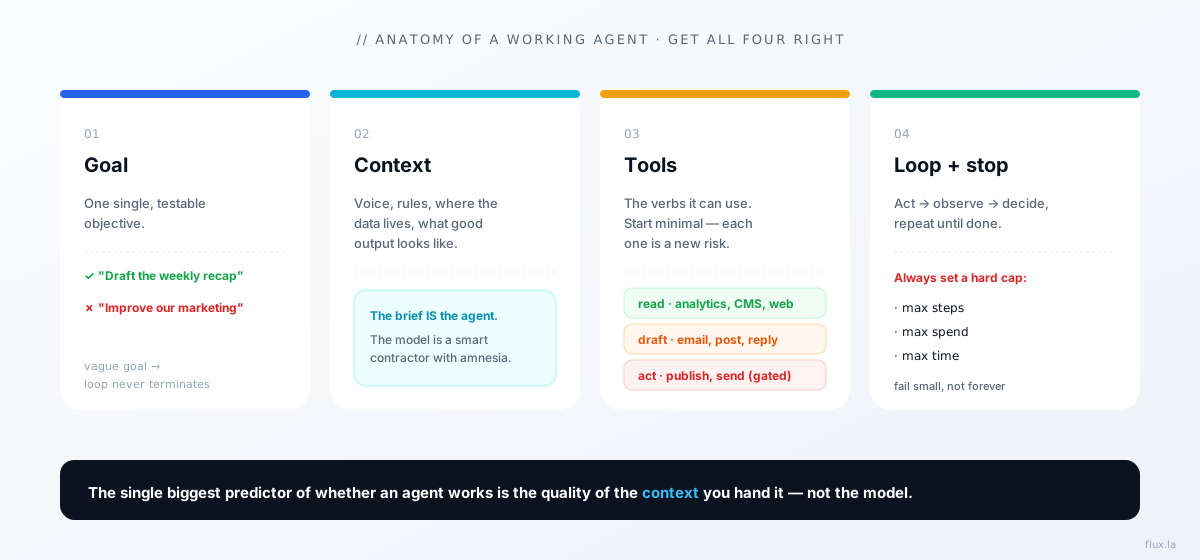
The single biggest predictor of whether an agent works isn’t the model — it’s the quality of the context you hand it. We’ve watched the same model go from useless to excellent on the same task purely by rewriting the brief.
Start with the SOP, not the model
Before you touch any tooling, write the task as a standard operating procedure a new hire could follow. If you can’t write that SOP, the agent can’t do the task — the gap isn’t the AI, it’s that the process was never actually defined.
A good agent SOP names: the exact inputs and where they live, the steps in order, the decision rules (“if CPA is above $40, flag it”), what good output looks like with an example, and what to escalate to a human. That document is most of your agent. The model just executes it.
Choosing the tools to expose
The art is giving the agent enough tools to do the job and no more. Each tool you add is a new way the agent can go wrong, so start minimal:
- Read tools first. Analytics, search, CMS read, ad-platform read. Read-only tools can’t break anything, so they’re where you build trust.
- Draft tools second. Create a draft email, a draft post, a draft reply. The output sits in a queue for a human, never goes live.
- Act tools last, gated. Publish, send, spend. Only add these once the agent has earned it, and even then put a human approval step in front of every irreversible action.
This maps directly to the deployment ladder: read → draft → act. Don’t hand a new agent the “send email” tool on day one no matter how good it looks in testing.
The guardrails that matter
Three guardrails prevent every expensive agent failure we’ve seen:
1. A human gate on anything irreversible or public. Sending, publishing, spending, replying in public. The agent prepares; a person approves. This single rule eliminates the catastrophic failure mode. It’s also why we never build “fully autonomous” public-facing agents — it violates the honest-UX principle that every shipped action should be one a human stands behind.
2. Hard limits. Max steps per run, max budget per day, max actions per hour. A bug should cost you a wasted run, not a blown ad budget or a hundred spam comments.
3. A log of every decision. The agent should write down what it did and why. When something goes wrong — and it will — the log is the difference between a five-minute fix and a mystery.
Single agent vs. multi-agent
Most marketing tasks need exactly one agent. Resist the urge to build a swarm before you’ve shipped a single working agent.
When you do scale, the pattern that works is a pipeline: each agent owns one stage and hands its output to the next. A research agent produces a brief, a drafting agent turns the brief into a post, an editing agent checks it against your rules. Each stage is independently testable, and a failure in stage two doesn’t corrupt stage one.
The pattern that doesn’t work well yet is fully autonomous multi-agent “teams” that negotiate among themselves with no human in the loop. They’re impressive in demos and fragile in production — errors compound across handoffs, and by step six the agents are confidently working on the wrong thing. Pipeline with checkpoints beats free-for-all every time.
A concrete first build: the weekly recap agent
Here’s the whole thing, end to end, because abstract advice doesn’t ship:
- Goal: Produce a one-page recap of last week’s marketing performance every Monday at 7am.
- Context: Last quarter’s recaps as examples, the list of metrics that matter, the threshold rules for flagging.
- Tools: Read access to your analytics and ad platforms. A draft tool to write the recap into a doc. No send, no publish.
- Loop: Pull the numbers → compute week-over-week deltas → flag anything past threshold → draft the recap in the house format → stop.
- Guardrail: Output lands in a draft doc. A human reads it before it goes to the team for the first month.
That agent saves a few hours a week, is impossible to get catastrophically wrong, and teaches you everything you need to build the next one. Once it’s solid, the same skeleton becomes a content-brief agent, a review-triage agent, or an ad-monitoring agent — swap the goal, context, and tools.
What we run for clients
We build agents the same way we tell clients to: start with the SOP, expose read tools first, gate every irreversible action, and graduate from internal to outward-facing only after a clean track record. Most engagements stand up three agents in the first month — research, reporting, and first-draft content — wired as a pipeline with human checkpoints.
If you want help architecting agents around your actual stack, tell us what you’re working on. Two slots open in Q3 2026.
Further reading
- AI agents for marketing teams in 2026 — the strategic overview and the five jobs agents do
- Building an AI content engine that ranks AND gets cited — the content pipeline as a multi-agent system
- How to A/B test in 2026 — how to actually measure whether an agent improved anything
One copyable AI agent, every Wednesday.
Flux founder Alejandro Rioja's weekly newsletter for operators: an agent he shipped that week, one growth experiment with real numbers, and what's working across SEO and GEO right now.
Free · 1-click unsubscribe · confirm by email and you're in.
Alejandro Rioja
Operator who builds and sells marketing-focused brands. Founder of Pickleland, founder of Flux.LA, writing about AI SEO + GEO at alejandrorioja.com.