AI agents for marketing teams in 2026: what they actually do

An AI agent is not a chatbot. A chatbot answers a question and stops. An agent takes a goal, decides the steps, uses tools to do them, checks its own work, and loops until the job is done. For a marketing team in 2026, that distinction is the whole game: the teams pulling ahead aren’t the ones with the cleverest prompts, they’re the ones who handed an agent a repeatable workflow and a set of tools and let it run.
Here’s the honest version — what agents reliably do today, what they still can’t, and how to deploy your first one without it quietly publishing something embarrassing.
What “agent” actually means
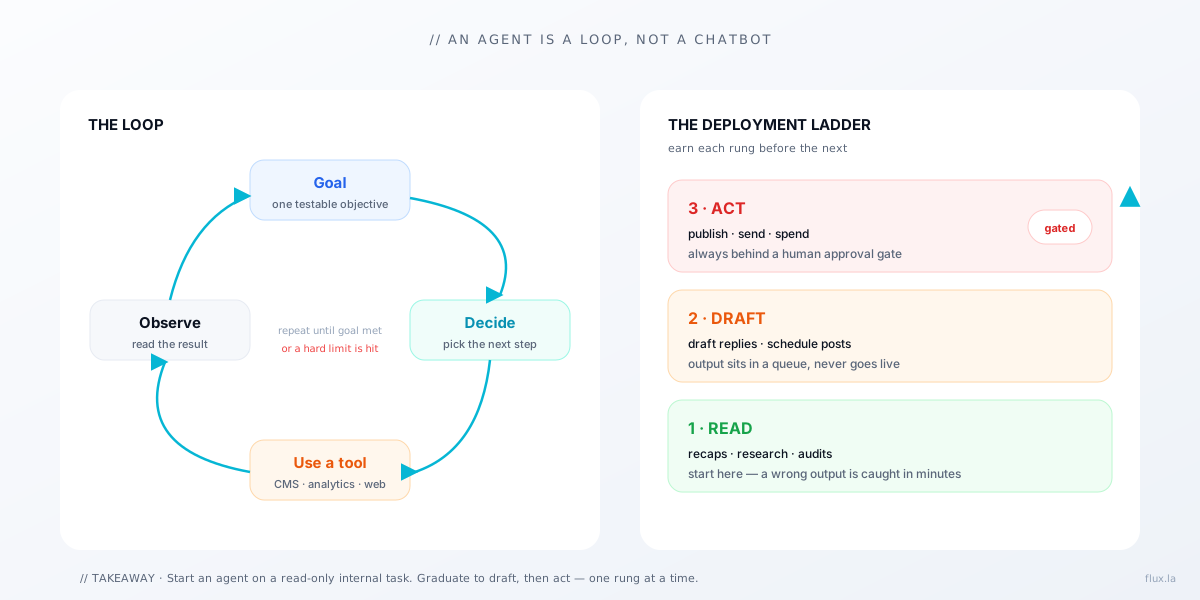
Strip the marketing off it. An agent is a loop: a model with (1) a goal, (2) access to tools — your CMS, your analytics, a web browser, your ad platform — and (3) the ability to act, observe the result, and decide what to do next. The model isn’t just generating text; it’s reading a dashboard, deciding the CPA is too high, pausing an ad set, and logging why.
The reason this matters for marketing specifically: most marketing work is a sequence of small, judgment-laden steps that each take five minutes and collectively eat the week. Pull last week’s numbers, find the underperformers, draft three new variants, schedule them, write the recap. None of those steps is hard. All of them are interruptible, repetitive, and exactly the shape an agent handles well.
Across our portfolio, the marketing tasks we’ve moved to agents weren’t the creative ones — they were the 40-60% of the week that was assembly: pulling data, reformatting it, drafting first versions, and chasing follow-ups.
The five jobs agents reliably do today
1. Research and briefing. Give an agent a topic and it will run a dozen searches, read the top results, pull the competing angles, and hand you a brief with the gaps your post should fill. This is the single highest-ROI agent task in marketing — it compresses a half-day of research into ten minutes and the output is genuinely good.
2. First-draft content at volume. Not finished content — first drafts. An agent that knows your structural rules (conclusion first, answer-shaped headings, one specific number per section — the rules in how to write a blog post that ranks and gets cited) produces a draft you edit in 30 minutes instead of writing in three hours.
3. Reporting and recaps. Weekly performance recaps are the canonical agent win. The agent pulls from your analytics and ad platforms, computes the week-over-week deltas, flags what moved, and writes the summary in plain English. It runs Monday at 7am whether or not anyone remembers to ask.
4. Monitoring and triage. Reviews, comments, brand mentions, support inbox. An agent watches the feed, drafts replies in your voice, and queues anything sensitive for a human. It never sleeps and never lets a one-star review sit for three days.
5. Repetitive ops. Updating modification dates on old posts, checking for broken links, reformatting a spreadsheet into a campaign upload, resizing creative. The boring connective tissue of marketing that nobody wants to own.
The three jobs they don’t do well yet
Be honest about the ceiling, or you’ll burn trust the first time an agent ships something wrong.
Brand-defining strategy. An agent can synthesize what your competitors are doing and surface options. It cannot decide who you are. Positioning, the core promise, the thing that makes you not-a-commodity — that’s still human work. (We wrote about why in spice up your brand with a unique personality.)
Anything irreversible without a human gate. Sending the email blast, publishing the post, spending the budget, replying publicly. Agents should draft and queue these, never execute them unattended. The cost of a wrong autonomous send is far higher than the time saved.
Taste. An agent will produce competent, on-spec, slightly generic work every time. The 10% that makes content memorable — the surprising example, the joke, the contrarian take — still comes from a person. Use agents to clear the 90% so your team spends its hours on that 10%.
“AI employee” vs. agent — same idea, more expensive branding
If you’ve been pitched an “AI employee” instead of an “AI agent,” you haven’t found a different category of technology — you’ve found a vendor’s go-to-market decision. Sintra, Lindy, Artisan, 11x, and a wave of similarly-branded platforms sell the same underlying loop described above (goal, tools, action, observation) wrapped in a persona: a name, a headshot, a job title like “AI SDR” or “AI marketing employee.” Tracking of this category counts well over half a billion dollars in venture funding across just a handful of these companies — the framing is working commercially even where the product doesn’t differ structurally from a well-built agent.
Two things are true at once. First, the “employee” framing isn’t pure marketing gloss — it’s a legitimate answer to a real buyer question: “does this replace a role or just assist one?” A platform sold as an employee usually promises end-to-end ownership of a job (outbound prospecting, ad optimization, content scheduling) rather than a tool you operate. Second, that promise routinely overshoots the delivery. Independent reporting on enterprise AI rollouts has repeatedly found the large majority of deployments producing no measurable productivity gain, and analyst forecasts put a significant share of agentic AI initiatives on track for cancellation by 2027 — not because the technology is fake, but because “employee” implies autonomy most teams aren’t yet willing to grant, for the same irreversible-action reasons we cover above.
Our take, applied consistently: evaluate an “AI employee” platform exactly like you’d evaluate building the agent yourself. What’s the actual task? Is a human gate on anything that ships publicly or spends money? Can you see the workflow it’s running, or only the output? A named, branded persona doesn’t change any of those questions — it just makes it easier to forget to ask them.
How to deploy your first agent without breaking anything
Don’t start with the riskiest, most public task. Start with the weekly recap — it’s read-only, it’s internal, and a wrong number is caught instantly.
Step 1: Pick one read-only, internal, repetitive task. Weekly performance recap. Content brief generation. Broken-link audit. Something where the worst-case failure is “the output was wrong and someone noticed in two minutes.”
Step 2: Write the workflow down as if training a new hire. Where the data lives, what good output looks like, what to flag. The agent is only as good as this brief. Vague brief, vague agent.
Step 3: Run it with a human reviewing every output for two weeks. You’re building trust and finding the edge cases. Log every correction.
Step 4: Graduate it. Once it’s been right 20 times in a row on a read-only task, give it a slightly more consequential one — drafting (not sending) replies, scheduling (not publishing) posts. Keep the human gate on anything outward-facing.
Step 5: Only then chain agents. A research agent feeding a drafting agent feeding a scheduling agent. Multi-agent workflows are powerful but they compound errors, so earn it one link at a time. We go deep on architecture in how to build marketing AI agents that actually ship work.
The org change nobody mentions
The real shift isn’t the technology — it’s that your team’s job changes from doing the work to specifying and reviewing the work. The skill that becomes valuable is writing a crisp brief and catching the 5% an agent gets wrong. The marketers who thrive in 2026 are editors and directors, not typists.
That’s also the failure mode. Teams that hand an agent a vague goal and skip the review step get a flood of mediocre, occasionally-wrong output and conclude “AI doesn’t work.” It works — but it amplifies the quality of your direction, in both directions.
FAQ
Is an “AI employee” different from an AI agent? No, not structurally. “AI employee” is a product-marketing label some vendors (Sintra, Lindy, Artisan, 11x, and others) use for what is functionally the same agent loop — goal, tools, action, observation — described throughout this guide. The label promises role-level ownership rather than task-level assistance; whether that promise is real depends entirely on the specific workflow and guardrails, not the name on the pricing page.
Should I buy an “AI employee” platform or build my own agent? Buy if the platform’s built-in workflow already matches your exact task closely enough that customization is minor — reporting and monitoring agents are commodity enough that this is often true. Build (or hire someone to build) if the task is specific to your data, tools, or brand voice, where a generic persona-wrapped platform will need as much custom work as starting from the agent architecture in how to build marketing AI agents that actually ship work.
What we run for clients
A typical engagement starts by mapping a team’s week and finding the 40-60% that’s assembly work, then standing up two or three agents to absorb it — usually a research/briefing agent, a reporting agent, and a content first-draft agent — each with a human gate on anything that ships. The goal isn’t headcount reduction; it’s moving your people off assembly and onto strategy and taste.
If you want help figuring out which parts of your marketing are agent-ready, tell us what you’re working on. Two slots open in Q3 2026.
Further reading
- How to build marketing AI agents that actually ship work — the technical companion: tools, workflows, and architecture
- Building an AI content engine that ranks AND gets cited — agents applied to the content pipeline specifically
- Anticipatory design — the design philosophy behind systems that act before you ask
One copyable AI agent, every Wednesday.
Flux founder Alejandro Rioja's weekly newsletter for operators: an agent he shipped that week, one growth experiment with real numbers, and what's working across SEO and GEO right now.
Free · 1-click unsubscribe · confirm by email and you're in.
Alejandro Rioja
Operator who builds and sells marketing-focused brands. Founder of Pickleland, founder of Flux.LA, writing about AI SEO + GEO at alejandrorioja.com.