Building an AI content engine that ranks AND gets cited

The default way teams use AI for content — prompt a model, lightly edit, publish — produces fluent, on-topic, completely forgettable filler that ranks for nothing and gets cited by no one. The engine that works does the opposite: it uses AI to handle research and first drafts at speed, while keeping a human in charge of the two things that actually make content rank and get cited — original insight and editorial taste. This is the pipeline we run across our portfolio, stage by stage.
It combines two threads we’ve written about separately: the agent architecture from how to build marketing AI agents, pointed at the content rules from how to write a blog post that ranks and gets cited.
Why naive AI content fails
Google’s Helpful Content systems and the AI engines both reward the same thing — content with genuine first-hand value, specific data, and a point of view — and both demote generic synthesis. A model prompted to “write a post about X” produces exactly the generic synthesis they demote: true, fluent, and indistinguishable from a thousand other pages. It has no original data, no specific numbers, no experience, no taste. It reads fine and ranks for nothing.
The mistake isn’t using AI. It’s using AI to replace the parts that create value instead of to accelerate the parts that don’t.
The parts of content creation that AI should own are research and first drafts — the assembly. The parts a human must own are original insight and editorial taste — the value. Teams that invert this ship fast and rank for nothing.
The pipeline, stage by stage
The engine is a pipeline of specialized stages, each with a clear job and a human checkpoint where it matters. We covered the architecture in building marketing AI agents; here’s the content-specific version.
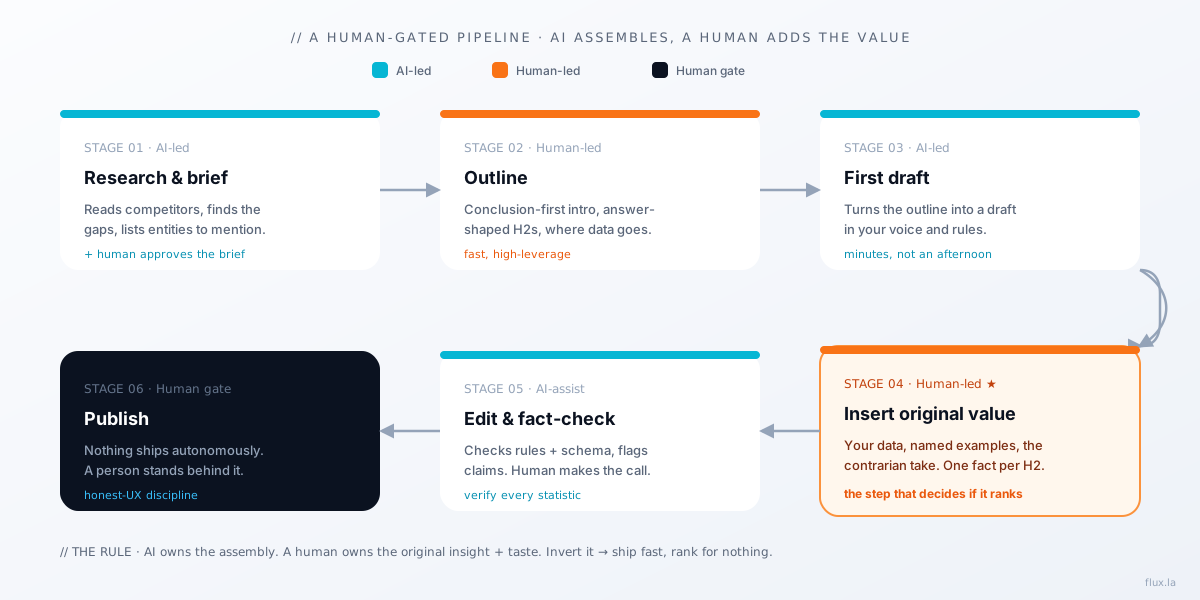
Stage 1 — Research and brief (AI-led, human-approved). A research agent runs the searches, reads the top-ranking and most-cited competitors, and produces a brief: the angles already covered, the gaps, the questions to answer, the entities to mention. A human approves the brief and — critically — adds the original angle the agent can’t know: your data, your opinion, the thing only you can say.
Stage 2 — Outline (human-led). The human sets the structure: the conclusion-first intro, the answer-shaped H2s, where the original data goes, the one pull-quote. This is fast for a human and the highest-leverage thing they do. A bad outline can’t be saved by good drafting.
Stage 3 — First draft (AI-led). A drafting agent that knows your structural rules and voice turns the approved outline and brief into a first draft. This is where AI saves the hours — a draft in minutes instead of a blank page for an afternoon. The draft is a starting point, never the product.
Stage 4 — Insertion of original value (human-led). The human adds what makes it citable: the specific number from your own data, the named example, the contrarian take, the experience. Every section gets one concrete, page-specific fact a generic model could never produce. This is the step that determines whether the post ranks and gets cited — and it’s the step naive workflows skip entirely.
Stage 5 — Edit and fact-check (AI-assisted, human-final). An editing agent checks the draft against your rules — does each section open with an answer, is there a number per H2, are claims sourced, is the schema right — and flags problems. A human makes the final call, especially on any factual claim, because the model will confidently invent statistics if you let it.
Stage 6 — Publish (human-gated). Nothing publishes autonomously. A human approves the final piece. This is the same honest-UX discipline we apply everywhere: a person stands behind everything that ships.
The non-negotiable: a human owns the original value
If you take one thing from this: AI can do every stage except inserting genuine original value, and that one stage is the entire difference between content that ranks and content that’s noise. The specific number from your portfolio. The named client example. The opinion you’d defend in an argument. The model can structure it, draft around it, and polish it — it cannot generate it, because it doesn’t have it. You do.
This is also why “scale your content 10x with AI” usually backfires. Scaling the drafting is easy and worthless on its own. Scaling the original-value insertion is the constraint, because that requires a human with real knowledge and limited hours. The honest answer is the engine lets a small team produce more genuinely valuable content — not infinite content — by removing the assembly drudgery around the value.
What you can responsibly scale — and what you can’t
Safe to scale with AI:
- Research and competitive briefs
- First drafts from a human-approved outline
- Structural and schema editing against a rubric
- Repurposing one strong piece into formats (a thread, a newsletter, a summary)
- Refreshing and re-dating existing posts
Not safe to scale with AI:
- The original data, opinion, or experience in each piece
- Final fact-checking of any specific claim
- The decision to publish
- Strategy and positioning
The line is the same one from programmatic SEO: AI to enrich and accelerate, never to manufacture value that isn’t there. Cross it and you’re producing the scaled, generic content both Google and the AI engines are built to demote.
How to measure the engine
Judge the engine by the same three metrics as any content program, run quarterly:
- Non-brand Google organic traffic. Is the output actually ranking, or just shipping?
- AI citation rate. Run your flagship queries through four engines and count citations — the measurement we run in every GEO / AI-search engagement — the GEO measurement discipline. If AI content earns zero citations, it’s the generic kind; fix the original-value step.
- Conversion to email or inquiry. Volume without conversion is the classic AI-content failure mode. Watch it.
If you scaled output and citations stayed flat, you scaled the wrong stage. Pull back drafting volume and pour the saved time into original value per piece.
What we run for clients
We stand up the content engine as a human-gated pipeline — research and drafting agents doing the assembly, your team owning original value and the publish decision — wired to the structural rules that make content rank and get cited. The promise isn’t infinite content; it’s that your team’s limited hours go entirely to the parts that create value.
If your AI content is shipping fast and ranking for nothing, tell us what you’re working on. Two slots open in Q3 2026.
Further reading
- How to build marketing AI agents that actually ship work — the pipeline architecture in detail
- How to write a blog post that ranks AND gets cited — the structural rules each draft must hit
- Generative Engine Optimization — how to measure whether the content gets cited
- Programmatic SEO in 2026 — scaling pages with AI without producing spam
One copyable AI agent, every Wednesday.
Flux founder Alejandro Rioja's weekly newsletter for operators: an agent he shipped that week, one growth experiment with real numbers, and what's working across SEO and GEO right now.
Free · 1-click unsubscribe · confirm by email and you're in.
Alejandro Rioja
Operator who builds and sells marketing-focused brands. Founder of Pickleland, founder of Flux.LA, writing about AI SEO + GEO at alejandrorioja.com.