Performance Max, honestly: when it works and when it burns budget

Performance Max can be the best-performing campaign in your account or the one quietly setting money on fire, and the difference is almost entirely about the guardrails you put on it. Pmax is Google’s most automated campaign type: you hand it assets, a budget, and a goal, and its AI decides where to show ads across Search, Shopping, YouTube, Display, Gmail, and Maps — with almost no levers and almost no transparency about where your money went. Used with discipline it’s powerful. Used naively it cannibalizes traffic you’d win for pennies and hides the evidence.
This is the honest operator’s guide. For where Pmax fits in the broader account, start with the 2026 SEM playbook.
What Performance Max actually is
You give Pmax creative assets (headlines, images, video, descriptions), an audience signal, a budget, and a conversion goal. Its AI then serves those assets across all of Google’s inventory and bids in real time toward your goal. You don’t choose placements, you can’t see most search terms, and the channel-level breakdown is deliberately thin.
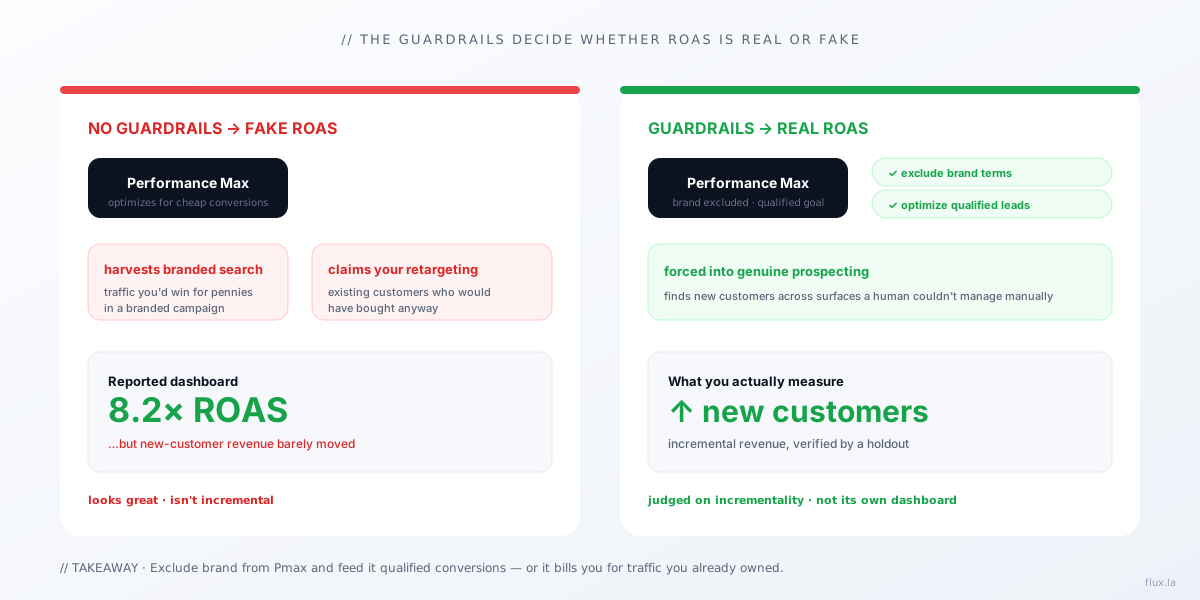
The pitch is “set your goal, let our AI find conversions everywhere.” Sometimes that’s exactly what happens. The catch is that Pmax is rewarded for reported conversions, and the cheapest reported conversions are often ones you’d have gotten anyway — your own brand searches and existing-customer retargeting. Left unchecked, Pmax happily claims credit for those and reports a gorgeous ROAS while adding little incremental revenue.
The most common Performance Max failure isn’t bad performance — it’s fake performance: the campaign harvests your branded and remarketing traffic, reports a stellar ROAS, and the new-customer revenue you actually wanted never materializes. The dashboard looks great while the business doesn’t move.
When Performance Max genuinely works
E-commerce with a clean product feed. Pmax was born from Smart Shopping and it’s strongest here. With a well-structured Merchant Center feed and real purchase-conversion data, it finds buyers efficiently across surfaces a human couldn’t manage manually.
Accounts with high, clean conversion volume. The AI needs data to learn. A campaign feeding it hundreds of real conversions a month will outperform your manual bidding. A campaign feeding it five noisy conversions will flail.
Prospecting once branded traffic is fenced off. When you explicitly exclude brand terms and existing customers, Pmax becomes what it’s supposed to be: a new-customer-finding engine. That’s where its breadth is an asset.
When it burns budget
Low conversion volume. With thin data the AI can’t learn and defaults to the easy, cheap, low-incrementality clicks. Below a real conversion threshold, manual or standard Smart Bidding campaigns beat it.
No brand exclusions. This is the number-one mistake. Without a brand exclusion list, Pmax eats your branded search traffic — the cheapest, highest-converting traffic you have — and reports it as Pmax success. You’re paying a premium for clicks you already owned.
Weak or generic creative. Pmax leans hard on your assets. Thin, off-brand, or low-quality creative produces thin, off-brand placements you can’t even see to fix.
Lead gen with bad conversion signals. If your “conversion” is a form fill rather than a qualified lead, Pmax will efficiently manufacture worthless form fills, often via low-quality Display and Gmail placements.
How to fence it in
Five guardrails turn Pmax from a black box into a controllable channel:
1. Exclude brand terms. Request brand exclusions so Pmax can’t claim your branded searches. Run those through a dedicated, cheap branded search campaign instead. This one change is the difference between real and fake ROAS.
2. Optimize toward qualified conversions. Feed Pmax your highest-quality conversion — ideally offline conversion data tied to closed deals, not raw form fills. The campaign becomes exactly as smart as the signal you give it.
3. Use account-level and campaign-level negatives. You now have more negative-keyword control over Pmax than in earlier years — use it. Exclude irrelevant and competitor-confusion terms aggressively.
4. Give it strong, varied creative. Multiple genuinely good headlines, real images, and video. Video especially — without it, Pmax can’t access YouTube inventory well and skews toward lower-quality Display.
5. Watch the placement and search-term insights you can see. Reporting is thin but not zero. Check the insights and asset reports weekly; if spend is pooling in junk placements, your creative or signals need work.
Reading the opaque reporting
Pmax tells you less than any other campaign type, so judge it on outcomes, not its own dashboard:
- Compare incremental new-customer revenue, not reported ROAS. Segment new vs. returning customers. If Pmax’s “wins” are mostly returning customers, it’s harvesting, not prospecting.
- Watch your branded search campaign for cannibalization. If branded volume drops when Pmax ramps, Pmax is stealing it. Brand exclusions fix this.
- Run a holdout if the budget justifies it. Pause Pmax in a region or for a window and see whether total conversions actually fall. This is the only way to know its true incrementality, and it’s uncomfortable precisely because the answer is often sobering.
The honest verdict
Performance Max is a sharp tool, not a magic button. For an e-commerce account with clean feed data, strong creative, brand exclusions, and qualified conversion tracking, it can be your best channel. For a low-volume lead-gen account with a form-fill goal and no guardrails, it’s an expensive way to generate a flattering dashboard and disappointing pipeline. The campaign type isn’t good or bad — your discipline is.
What we run for clients
When we run Pmax, brand exclusions and qualified-conversion tracking go on before the campaign launches, never after. We segment new vs. returning revenue to catch harvesting, feed strong creative, and run holdouts on larger budgets to verify the campaign is actually incremental rather than just well-reported.
If your Performance Max numbers look too good to be true, they might be — tell us what you’re working on and we’ll pressure-test them. Two slots open in Q3 2026.
Further reading
- SEM in 2026: paid search when the SERP is half AI — the account-wide strategy Pmax sits inside
- Local SEO in 2026 — the organic side of the local intent Pmax also chases
- How to A/B test in 2026 — measuring incrementality when significance is hard to reach
One copyable AI agent, every Wednesday.
Flux founder Alejandro Rioja's weekly newsletter for operators: an agent he shipped that week, one growth experiment with real numbers, and what's working across SEO and GEO right now.
Free · 1-click unsubscribe · confirm by email and you're in.
Alejandro Rioja
Operator who builds and sells marketing-focused brands. Founder of Pickleland, founder of Flux.LA, writing about AI SEO + GEO at alejandrorioja.com.