SEM in 2026: paid search when the SERP is half AI

Paid search still works in 2026 — but on a smaller, more expensive battlefield than it used to. AI Overviews now sit above the fold on a large share of informational queries, pushing ads down and gutting the cheap top-of-funnel clicks that used to fill accounts. The money is now concentrated in high-intent, bottom-of-funnel queries where someone is ready to buy, and the accounts that win are the ones structured so Google’s automation works for you instead of quietly spending your budget on garbage.
This is the honest SEM playbook: what changed, where to put money, and how to keep control of an account the platform desperately wants to run on autopilot. The flip side — earning the citations inside those AI Overviews rather than buying the space beneath them — is our GEO / AI-search service.
What AI Overviews did to paid search
For years, paid search’s bread and butter included a lot of informational queries — “what is X,” “how to do Y” — where you’d buy a cheap click and nurture from there. AI Overviews answer most of those queries directly now, so the user never scrolls to your ad. Those clicks got more expensive and lower quality almost overnight.
What survived, and even got stronger, is high commercial intent: “buy X,” “X pricing,” “X near me,” “best X for [specific use],” branded competitor terms. On those queries the user wants a vendor, not an explainer, and AI Overviews are less likely to fully resolve the query. That’s where paid search concentrates now.
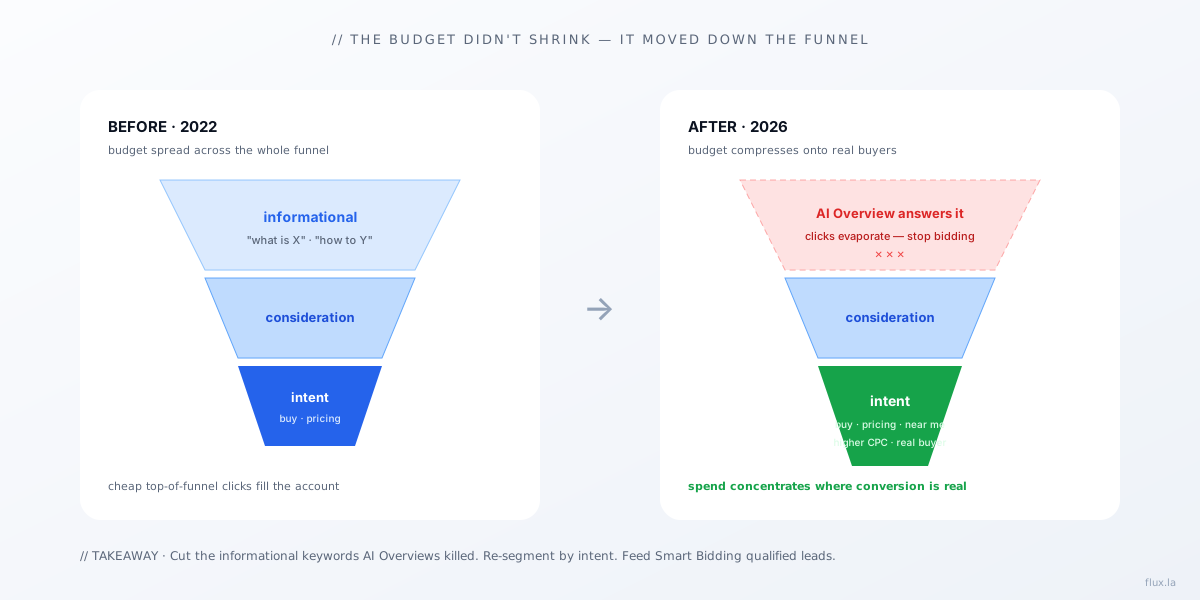
The shift isn’t “paid search is dying” — it’s that the cheap top-of-funnel clicks evaporated and the budget compressed onto bottom-of-funnel intent, where CPCs are higher but the buyer is real. Accounts that didn’t re-segment kept paying for clicks that no longer convert.
Where paid search still wins decisively
Bottom-of-funnel commercial queries. Anyone searching “X pricing” or “X demo” is in-market. These clicks are expensive and worth it. This is the core of a 2026 SEM account.
Branded defense. Bidding on your own brand terms is cheap and stops competitors from intercepting people already looking for you. Skip this and you’re handing warm traffic to whoever bids on your name.
Local intent. “Near me” and geo-modified service queries still convert hard and are less disrupted by AI Overviews. If you serve a place, this is some of the best-spending you can do — and it compounds with local SEO.
Retargeting in-market audiences. People who hit your pricing page and left. Cheap, high-converting, and unaffected by what’s happening at the top of the SERP.
Where it’s quietly bleeding money
Broad informational keywords. If you’re still bidding on “what is [category],” you’re paying for clicks AI Overviews already satisfied. Audit these and cut hard.
Unconstrained broad match. Google pushes broad match plus Smart Bidding as the default. Left unconstrained, broad match will spend your budget on tangential queries that look like volume and convert like noise. It can work — but only with tight negative keyword lists and conversion data the algorithm can actually optimize toward.
Performance Max without guardrails. Pmax is Google’s black-box, all-inventory campaign type. It can perform, but it also cannibalizes branded traffic and hides where your money went. We gave it its own honest breakdown in the Performance Max guide — read it before you turn one on.
Structuring an account the automation can’t ruin
The core tension in 2026 SEM: Google’s automation is genuinely good at bidding and genuinely motivated to spend your whole budget. You win by feeding it clean signals and fencing off the parts you don’t want it to touch.
Feed it real conversions, not proxies. Smart Bidding is only as good as the conversion it optimizes toward. If you’re optimizing for “form view” instead of “qualified lead,” the algorithm will efficiently buy you worthless form views. Define conversions that map to revenue, and where you can, feed back offline conversion data so the algorithm learns which clicks became customers.
Segment by intent, not by topic. Separate campaigns for branded, high-intent non-brand, and local. Different intent means different value-per-click and different bidding targets. Lumping them together lets the algorithm spend your high-intent budget on low-intent clicks.
Build aggressive negative keyword lists. This is the manual work that keeps broad match honest. Review the search terms report weekly and exclude everything irrelevant. This single habit separates profitable accounts from budget bonfires.
Protect brand from Pmax. If you run Performance Max, exclude your brand terms so it doesn’t take credit for traffic you’d have won for pennies through a branded search campaign.
Measuring SEM when attribution is messier than ever
Attribution got harder — AI Overviews, privacy changes, and longer cross-device journeys all blur the picture. Don’t pretend last-click is truth. Three honest metrics:
Cost per qualified lead, not cost per click or even cost per lead. A lead that sales can’t close is a cost, not a conversion. Tie spend to qualified pipeline.
Incrementality on brand. Before you congratulate a campaign for branded conversions, ask whether those people would’ve found you anyway. Run a geo holdout if the budget is large enough to justify it.
Blended CAC across paid and organic. Paid and organic feed each other — someone sees an AI Overview citing you, then clicks your ad. Judge the system, not the silo. This is also why SEM and GEO belong in the same plan.
What we run for clients
A typical SEM engagement starts by re-segmenting the account around intent, cutting the informational keywords AI Overviews killed, tightening conversion tracking to qualified leads, and putting guardrails on Google’s automation before it spends. We pair it with the organic side so paid and earned traffic reinforce instead of competing.
If your paid search numbers slipped when AI Overviews launched, tell us what you’re working on. Two slots open in Q3 2026.
Further reading
- Performance Max, honestly — when Google’s AI campaigns work and when they burn budget
- Local SEO in 2026 — the organic side of local intent
- How SEO actually works in 2026 — why paid and organic belong in one plan
- How to A/B test in 2026 — testing ad variants when you don’t have huge traffic
One copyable AI agent, every Wednesday.
Flux founder Alejandro Rioja's weekly newsletter for operators: an agent he shipped that week, one growth experiment with real numbers, and what's working across SEO and GEO right now.
Free · 1-click unsubscribe · confirm by email and you're in.
Alejandro Rioja
Operator who builds and sells marketing-focused brands. Founder of Pickleland, founder of Flux.LA, writing about AI SEO + GEO at alejandrorioja.com.