Local SEO in 2026: ranking in Maps, Google, and AI answers

Local SEO in 2026 means winning three surfaces at once: the Google Map Pack, classic local organic results, and the AI answer that increasingly recommends one business when someone asks “where should I go for X near me.” The fundamentals that have always driven local ranking — a complete Google Business Profile, consistent citations, and real reviews — still do most of the work. What’s new is the AI layer, and it’s the thing most local businesses haven’t touched, which makes it the easiest place to get ahead.
This is the full local playbook, fundamentals first, AI layer second.
The three surfaces you now compete on
The Map Pack. The block of three businesses with the map, still the highest-converting local real estate there is. Driven heavily by your Google Business Profile, proximity, and reviews.
Classic local organic. The blue links below the pack. Driven by your website’s local relevance, content, and authority — standard SEO, pointed at local intent.
AI answers. When someone asks ChatGPT, Gemini, or Google’s AI Overview “best [service] in [city],” the engine increasingly names specific businesses. Being the business it names is a new, barely-contested surface — and it draws on your reviews, your citations, and your structured data.
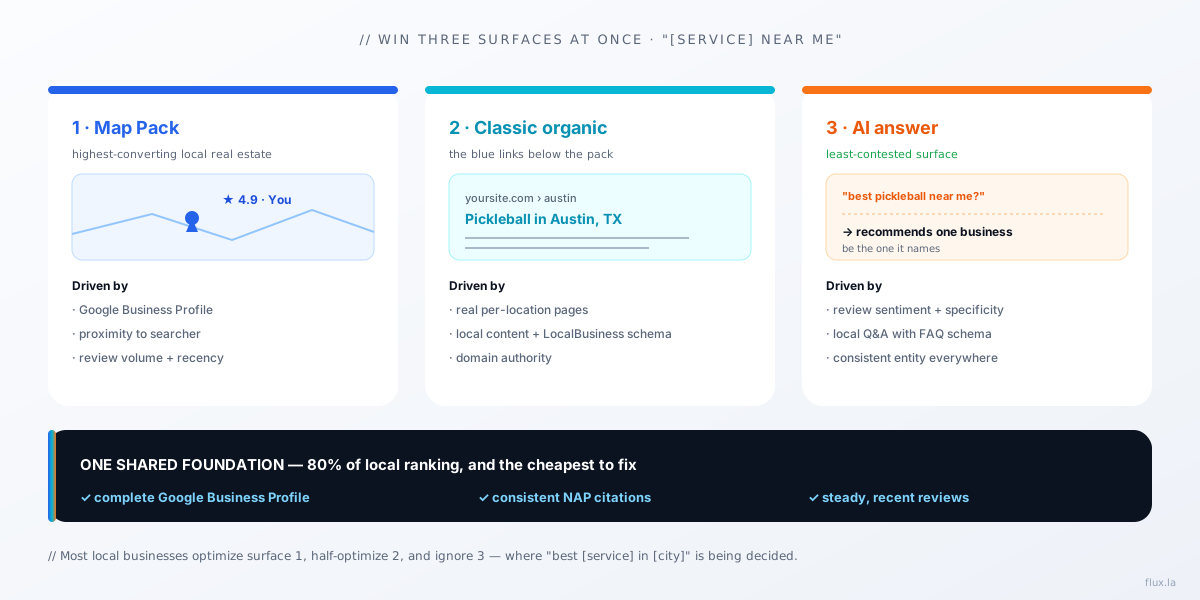
Most local businesses optimize only the first surface, half-optimize the second, and completely ignore the third. The AI answer surface is where “best [service] in [city]” queries are quietly being decided, and almost nobody local is competing for it yet.
The fundamentals that still do most of the work
Get these right before anything fancy. They’re 80% of local ranking and they’re unglamorous.
A complete, accurate Google Business Profile. This is the single biggest local ranking factor and the cheapest to fix. Right primary category (and relevant secondary categories), exact hours, real photos, services listed, and a description with your actual service and city. An incomplete profile is the most common reason a local business doesn’t rank, and it’s free to fix in an afternoon.
NAP consistency across the web. Your Name, Address, and Phone number must match exactly everywhere they appear — your site, Google, Yelp, Apple Maps, directories, Facebook. Inconsistencies (Suite vs. Ste., an old phone number) confuse the entities and suppress ranking. Audit and fix them.
Reviews — volume, recency, and responses. Reviews drive both Map Pack ranking and human conversion, and they’re now a major input to which business an AI names. The pattern that wins: a steady stream of recent reviews (not a pile from two years ago), and a response to every one, good or bad. Asking every happy customer for a review is the highest-ROI local marketing there is.
Local citations. Listings in the directories that matter for your industry and area. Consistent, claimed, and complete. They corroborate that you’re a real, established local entity.
The website layer
Your Business Profile gets you into the Map Pack; your website wins the organic results and feeds the AI answer.
A real page per location and per service. If you serve three cities or offer five services, each deserves a genuine page with specific local content — not a templated stub with the city swapped (that’s the trap from programmatic SEO). Real local detail: neighborhoods served, local specifics, photos, location-relevant FAQs.
LocalBusiness schema. Mark up your name, address, phone, hours, geo coordinates, and service area. This is how you hand the structured facts directly to Google and to AI engines instead of making them guess. It’s the most underused piece of local technical SEO.
Local content that proves you’re of the place. Guides, local event mentions, neighborhood context. Content that only a real local business would write signals genuine local relevance — and it’s exactly the kind of distinctive content engines cite. (We’ve written about a hyper-local content approach in how to promote your pickleball facility.)
The AI layer most local businesses are ignoring
When an AI engine answers “best [service] in [city],” it’s synthesizing from reviews, citations, structured data, and content across the web. You influence that answer with the same inputs as everything above — plus a few GEO moves aimed at local intent:
Reviews are now AI training signal. Engines read review sentiment and themes. A business with 200 reviews that repeatedly mention “fast,” “friendly,” and a specific service is far more likely to be named than one with 12 generic reviews. Encourage specificity, not just stars.
Answer local questions on your site, in Q&A format. “What’s the best time to visit?” “Do you serve [neighborhood]?” “How much does [service] cost in [city]?” Marked up with FAQ schema, these are exactly what AI engines extract to answer local queries. The structural rules in answer engine optimization apply directly.
Keep everything fresh and dated. Engines prefer current sources. A profile and site that obviously haven’t been updated in two years lose to an actively maintained competitor.
Be a clear, consistent entity. The same name, the same details, corroborated everywhere. Local AI recommendations go to businesses the engine is confident about, and confidence comes from consistency across many sources.
How to measure local performance
Map Pack rank for your core queries, by location. Rankings vary by where the searcher physically is, so check from your actual service area, not your office across town. Use a geo-grid tool, not a single check.
Direction requests and calls from your Business Profile. These are real intent and they’re in your profile insights. They predict revenue better than impressions.
“Near me” and branded-local conversions on site. Segment local-intent traffic and track whether it converts.
AI-answer presence. Run your top local queries (“best [service] in [city]”) through ChatGPT, Gemini, and Google AI Overviews quarterly and log whether you’re named. It’s the local version of the GEO citation audit we run as part of our GEO / AI-search service, and it’s the surface with the least competition.
What we run for clients
A local engagement starts with the unglamorous fundamentals — Business Profile completeness, NAP consistency, a review system that actually generates recent reviews — then the website layer (real per-location pages, LocalBusiness schema) and the AI layer (review specificity, local Q&A, entity consistency). We track Map Pack rank by geo-grid and AI-answer presence so you can see all three surfaces.
If you serve a place and want to own all three local surfaces, tell us what you’re working on. Two slots open in Q3 2026.
Further reading
- SEM in 2026 — the paid side of local intent
- Generative Engine Optimization — the citation discipline behind the AI-answer surface
- How to promote your pickleball facility — local marketing applied to a real venue
One copyable AI agent, every Wednesday.
Flux founder Alejandro Rioja's weekly newsletter for operators: an agent he shipped that week, one growth experiment with real numbers, and what's working across SEO and GEO right now.
Free · 1-click unsubscribe · confirm by email and you're in.
Alejandro Rioja
Operator who builds and sells marketing-focused brands. Founder of Pickleland, founder of Flux.LA, writing about AI SEO + GEO at alejandrorioja.com.