Answer Engine Optimization: how to get cited by AI engines

Answer Engine Optimization is the engineering discipline of making your content machine-readable so AI engines can extract a clean answer from it. If GEO is the strategy — be citable, be dense, be dated — AEO is the implementation: the entities, schema, and question-and-answer structure that let a model lift your content with confidence. You can have great content and still lose the citation to a worse competitor who formatted theirs for machines. This guide closes that gap.
Read the GEO guide first for the strategy. This is the build sheet. Want it done for you? See our GEO / AI-search service page.
Why “answer engine” and not just “search engine”
A search engine returns documents and lets the human extract the answer. An answer engine — ChatGPT, Perplexity, Gemini, the AI Overview at the top of Google — extracts the answer for the user and cites where it came from. That shift changes what you optimize. You’re no longer optimizing a page to be clicked; you’re optimizing a passage to be quoted. The unit of optimization shrinks from the document to the paragraph.
That’s why two pages with identical information can perform completely differently in AI answers. The one structured as discrete, self-contained, clearly-labeled answers gets pulled. The one written as a flowing essay with the key fact buried in paragraph four does not.
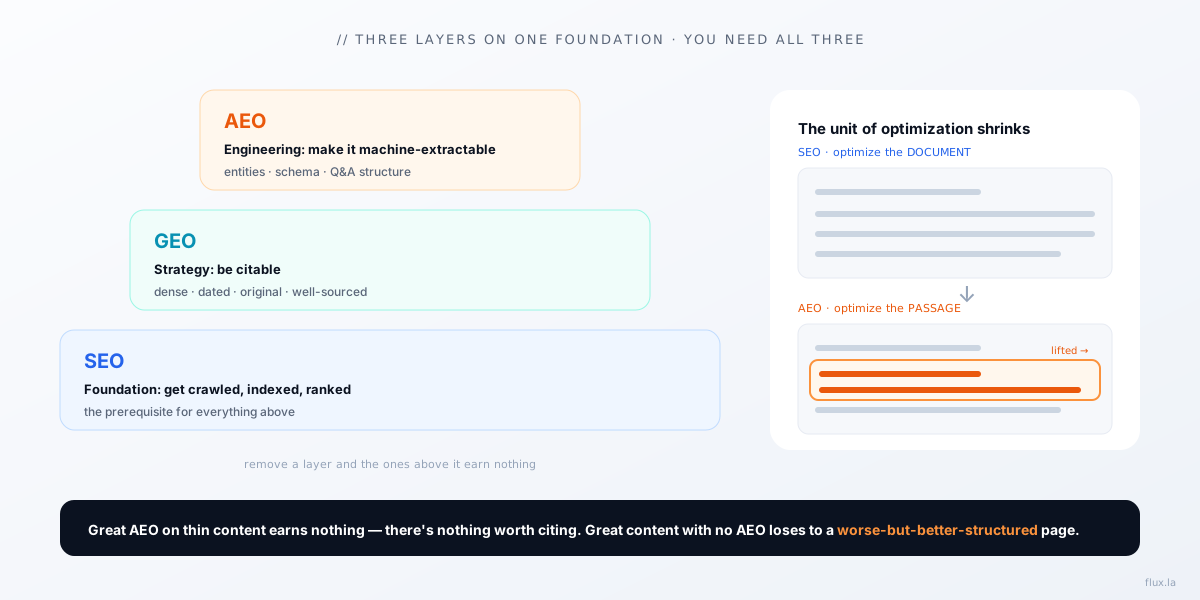
The unit of AEO is the extractable passage, not the page. Optimize each section to stand alone as a complete answer to one specific question, and you become the source an engine reaches for.
Entities: the thing most sites get wrong
AI engines reason about entities — people, companies, products, concepts — and the relationships between them, not just keywords. To be cited as an authority on a topic, the engine has to confidently understand who you are and what you’re an authority on.
Be a clear entity yourself. A consistent name, a real About page, an Organization and Person schema, and corroborating references across the web (an LinkedIn, a Crunchbase, mentions on other sites). Engines triangulate. A site with no entity footprint gets treated as anonymous and rarely cited by name.
Disambiguate. If your brand name is a common word, the engine may confuse you with something else. Tie yourself to your domain, your founder, and your niche consistently so the model can tell which “flux” you are.
Connect entities explicitly. When you mention a tool, a person, or a concept, link it and describe the relationship. “We use Google Search Console to filter brand queries” tells the engine more than “we use a tool.” Explicit relationships build the graph the engine reasons over.
Schema: the structured-data checklist
Schema markup is how you hand the engine a machine-readable summary instead of making it guess. Implement it completely or skip it — half-done schema confuses more than it helps.
On every blog post:
Articlewithheadline,datePublished,dateModified,author,wordCount, andarticleSectionPersonfor the author, linked to a real author pageBreadcrumbListfor the path
Where the content supports it:
FAQPagewhen you have 3+ genuine question-and-answer pairs. This is the highest-leverage schema for AEO — it maps your content directly onto the question/answer shape engines extract.HowTofor step-by-step content, with each step marked upOrganizationon your homepage and service pages, withsameAslinks to your profiles elsewhere
Validate everything at validator.schema.org. The most common audit failure we find is Article markup with no dateModified — engines use that field to judge freshness, and leaving it out quietly costs citations.
Formatting for extraction
Beyond schema, the literal layout of your text determines how extractable it is:
Lead each section with a one-sentence answer. Then elaborate. The engine grabs the lead sentence; the elaboration earns trust.
Use real question headings. “How do I get cited by Perplexity?” as an H2, answered immediately beneath, is the single most extractable structure there is. It mirrors exactly how the query arrives at the engine.
Prefer lists and tables for comparable data. “Plan A costs $X and includes Y; Plan B costs $Z” as a table is trivially extractable. The same information in prose often isn’t.
Keep answers self-contained. A passage that says “as mentioned above” can’t be lifted cleanly — the engine would have to include the “above” too, so it skips you for a competitor whose paragraph stands alone.
How AEO and GEO and SEO stack
Think of it as three layers on the same foundation:
- SEO gets the page crawled, indexed, and ranked — the prerequisite for everything.
- GEO is the strategy of being citable: dense, dated, original, generously sourced.
- AEO is the engineering that makes the citable content machine-extractable: entities, schema, Q&A structure.
You need all three. Great AEO on thin content earns nothing — there’s nothing worth citing. Great content with no AEO loses to a worse-but-better-structured competitor. The sites that win do the content work and the formatting work.
A 60-minute AEO pass for any post
Run this on your top 10 posts and you’ll see citations move:
- Add complete
Article+Personschema, includingdateModified. (15 min) - Add
FAQPageschema for any genuine Q&A in the post. (10 min) - Rewrite each H2 as a question or a claim. (10 min)
- Make sure each section opens with a one-sentence answer. (15 min)
- Link every entity — tools, people, concepts — to a real reference. (10 min)
That hour, repeated across your flagship content, is the highest-ROI technical work in 2026 marketing.
What we run for clients
Our GEO engagements include a full AEO build: entity footprint, complete schema across the site, and a structural rewrite of flagship posts into extractable Q&A. We validate every schema type and re-run the citation audit to confirm the formatting actually moved the number.
If you want a machine-readability audit of your site, tell us what you’re working on. Two slots open in Q3 2026.
Further reading
- Generative Engine Optimization: the complete guide — the strategy this implements
- GEO vs. SEO: what’s actually different — the direct comparison, for scoping which one you need
- How SEO actually works in 2026 — the foundation underneath both
- How to write a blog post for SEO — the post-level structural rules
One copyable AI agent, every Wednesday.
Flux founder Alejandro Rioja's weekly newsletter for operators: an agent he shipped that week, one growth experiment with real numbers, and what's working across SEO and GEO right now.
Free · 1-click unsubscribe · confirm by email and you're in.
Alejandro Rioja
Operator who builds and sells marketing-focused brands. Founder of Pickleland, founder of Flux.LA, writing about AI SEO + GEO at alejandrorioja.com.