Generative Engine Optimization (GEO): the complete 2026 guide

Generative Engine Optimization is the practice of getting your content cited inside AI answers — ChatGPT, Perplexity, Gemini, Claude, and Google’s AI Overviews — rather than just ranked in a list of blue links. It’s not a replacement for SEO; it’s the layer on top of it that’s growing 30-40x while classic informational traffic shrinks. If you only do one new thing in 2026, do this.
We covered how GEO and SEO fit together in how SEO actually works in 2026. This guide goes deep on the GEO half: the mechanics of citation, the specific changes that earn it, and how to measure something most operators can’t even see. If you’re evaluating this as a service rather than a DIY project, see our GEO / AI-search service page for how we scope and run this work.
How AI engines decide what to cite
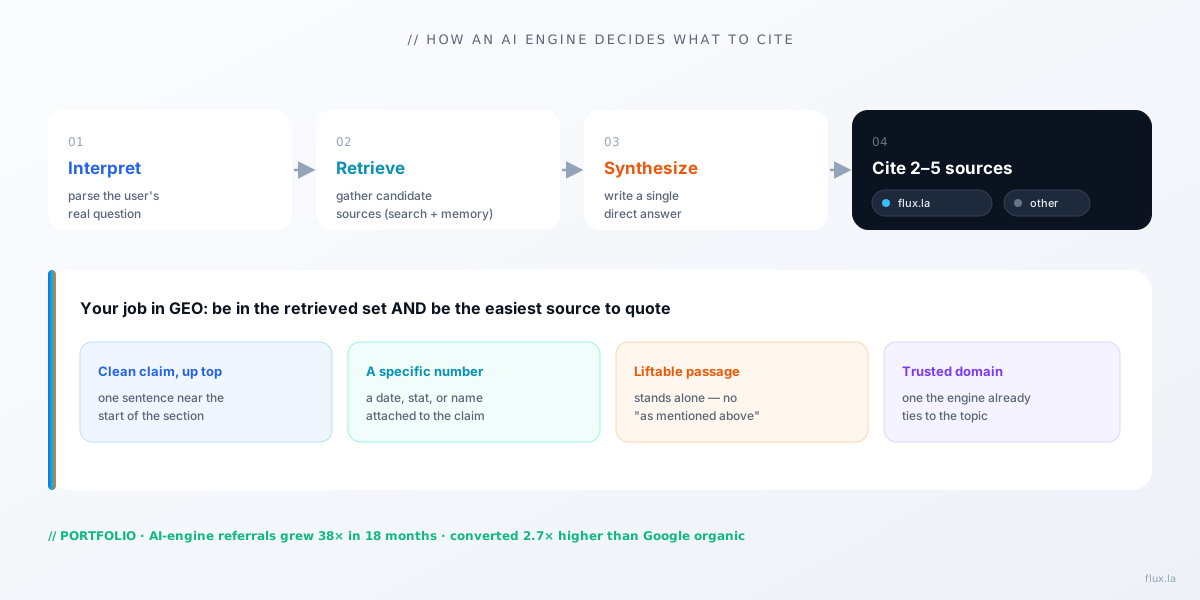
An AI engine answering a query does roughly this: it interprets the question, retrieves a set of candidate sources (sometimes a live web search, sometimes its training data, usually both), synthesizes an answer, and attaches 2-5 citations to the sources it leaned on. Your job in GEO is to be in that retrieved set and to be the source that’s easiest to quote.
“Easiest to quote” is the whole craft. Engines favor content that:
- States a claim cleanly in one sentence, near the top of the section
- Attaches a specific number, date, or name to that claim
- Is structured so the relevant passage can be lifted without surrounding context
- Comes from a domain the engine already associates with the topic
Across 14 portfolio sites in Q1 2026, AI-engine referrals grew 38x in 18 months and converted at 2.7x the rate of Google organic — because a user arriving from an AI citation has already been pre-qualified by the engine.
The content changes that earn citations
Answer in the first 50 words. Engines extract the top of the page. A section that opens with 200 words of throat-clearing gets skipped in favor of one that leads with the answer. Every section should be readable as a standalone answer to a question.
Phrase headings as questions or claims. “How AI engines decide what to cite” beats “The Citation Landscape.” The first matches how a person asks; the second matches a magazine table of contents. Engines match the former.
One citable fact per section. “Traffic grew” is not citable. “AI-engine referrals grew 38x across 14 sites in 18 months” is. Engines cite the specific version and ignore the vague one. If a section has no number, name, or date, it won’t get pulled.
One pull-quote per post. Wrap your single most quotable claim in a blockquote. Engines disproportionately treat blockquoted text as “the key takeaway” and lift it directly. We do it once per post, on purpose, on the most citable line.
Cite your own sources generously. Engines treat content that links to primary sources — official docs, dated reports, research — as more trustworthy, and more citable. The old “don’t link out” advice is actively harmful for GEO. Be the page that cites well and you become the page that gets cited.
The technical layer: make yourself retrievable
Citation-worthy content that the engine can’t find or parse earns nothing. The technical floor:
Publish llms.txt. A plain-text index at the root of your domain telling AI crawlers which pages are canonical and what each covers. It’s an hour of work and it measurably increases citations within 60 days. Full walkthrough in the llms.txt guide.
Ship clean, complete schema. Article, Person, Organization, FAQPage, HowTo where they apply. Engines use structured data to understand entities and relationships. Half-implemented schema — Article tags with no dateModified or wordCount — is barely better than none. We go deep in answer engine optimization.
Keep content crawlable and fast. If a generative engine’s crawler can’t render your page, or it times out, you’re invisible. Static sites clear this bar by default; heavy JS sites often don’t.
Date everything. Visible publish and modification dates, plus dateModified in schema. Engines strongly prefer fresh sources and will pick a dated competitor over your undated page even if yours is better.
Measuring GEO when there’s no analytics for it
This is where most operators give up, because there’s no Search Console for citations. You have to measure it manually, and the fact that almost nobody does is exactly why the metric is valuable.
The citation audit. Pick 10 flagship queries — the questions your ideal customer asks. Run each through ChatGPT, Perplexity, Gemini, and Google AI Overviews. That’s 40 lookups. Log which of your URLs (if any) get cited. Repeat quarterly. Your citation rate is the number that actually predicts AI traffic, and watching it move is the only honest feedback loop GEO has.
Referral traffic by source. AI engines increasingly pass referrer data. Segment it in your analytics. It’s still small in absolute volume but it’s the highest-converting segment you have — track its growth rate, not its size.
Goal for a 90-day program: at least 30% citation rate on your flagship queries. That’s achievable for a focused site in a defined niche; it’s not achievable if you’re trying to rank for everything.
The strategic shift: get cited, not linked
In classic SEO the prize is a backlink. In GEO the prize is being named in the answer — even when there’s no clickable link at all. A user who reads “according to flux.la, AI referrals convert 2.7x higher” and then searches your brand is a win, even though no click was logged. This breaks every dashboard built for the link era, which is why most teams are still optimizing for a game that’s shrinking.
The operators winning in 2026 publish dense, dated, citable content; ship the technical layer (llms.txt + complete schema); and track citation rate by hand every quarter. None of it is exotic. It’s just new, and most of the industry is still arguing about whether SEO is dead instead of doing it.
What we run for clients
A GEO engagement starts with a citation audit — your baseline across 4 engines and 10 queries — then a technical pass (llms.txt, schema, dates, crawlability) and a content engine built to the rules above. We re-run the citation audit at 45 and 90 days so you can watch the number move. Pricing starts at $8K for the audit and plan, $12K for the full engagement.
If you want to know whether GEO matters for your business, tell us what you’re working on. Two slots open in Q3 2026.
Further reading
- GEO vs. SEO: what’s actually different — the direct comparison, for scoping which one you need
- How SEO actually works in 2026 — how the classic and generative playbooks fit together
- Answer Engine Optimization — the entity and schema layer that makes you machine-readable
- The llms.txt guide — the one-hour technical setup that earns citations
- Hidden SEO tactics that still rank in 2026 — the tactical companion
- AI visibility tracking tools — when to automate the citation audit above with dedicated software
One copyable AI agent, every Wednesday.
Flux founder Alejandro Rioja's weekly newsletter for operators: an agent he shipped that week, one growth experiment with real numbers, and what's working across SEO and GEO right now.
Free · 1-click unsubscribe · confirm by email and you're in.
Alejandro Rioja
Operator who builds and sells marketing-focused brands. Founder of Pickleland, founder of Flux.LA, writing about AI SEO + GEO at alejandrorioja.com.