Programmatic SEO in 2026: scale without getting demoted


Programmatic SEO is generating many pages from a template and a dataset — one page per city, per product, per use case — to capture long-tail search demand at scale. Done right, it’s how sites like Zapier and Wise own thousands of high-intent queries. Done wrong, it’s a mass-produced doorway-page farm that Google’s spam systems now demolish in weeks. In 2026 the line between the two got sharper, because AI made churning out ten thousand thin pages trivial — and Google’s Helpful Content systems got much better at spotting exactly that.
This is how to scale page count without getting your whole domain demoted.
What programmatic SEO is — and isn’t
The legitimate version: you have a real dataset where each entry genuinely deserves its own page because it serves a distinct search intent. “Flights from [city A] to [city B],” “[job title] salary in [city],” “best [category] for [use case].” Each page answers a specific query with specific, useful data. The template is just the efficient way to publish data that’s genuinely different per page.
The version that gets you penalized: you have a thin template and you spin it across a keyword list, mad-libbing in a city name or a synonym, producing pages that are 95% identical and add nothing a user couldn’t get elsewhere. That’s a doorway-page farm, and it’s exactly what Google’s spam policies target by name.
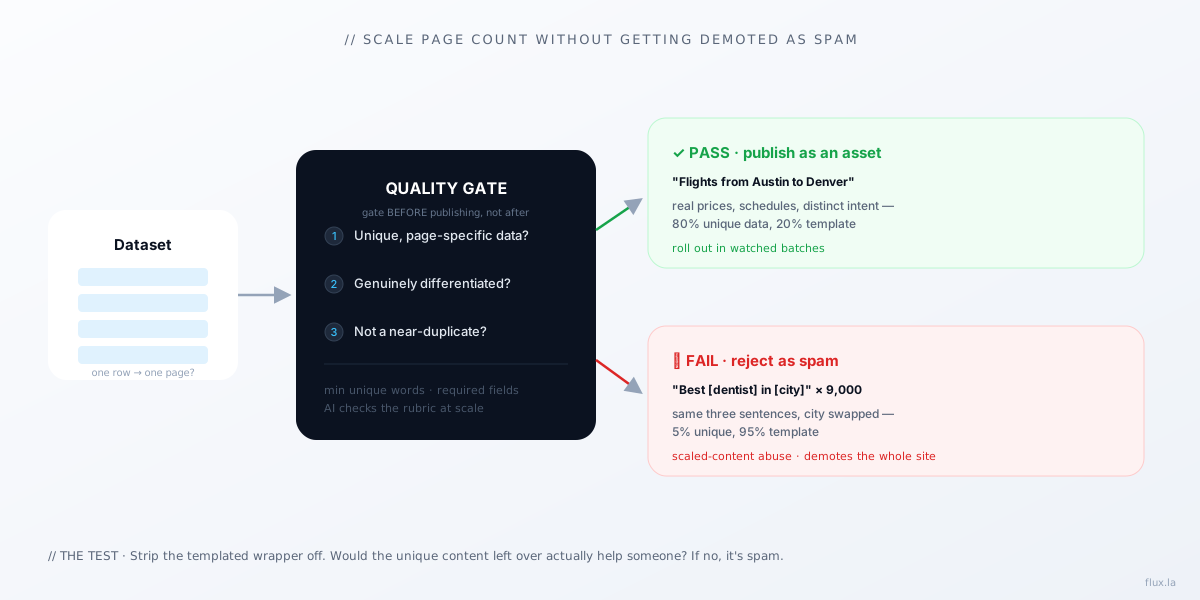
The test Google now applies, and you should apply first: if you stripped the templated wrapper off a programmatic page, would the unique content left over actually help someone? If the answer is “it’s the same three sentences with the city swapped,” the page is spam and it’s a liability to your whole domain.
Why 2026 raised the stakes
Two things changed. First, AI made it possible to generate not just templated stubs but thousands of plausibly-written pages — fluent, on-topic, and empty. Google responded with the March 2024 core and spam updates and has kept tightening: “scaled content abuse” is now an explicit, sitewide-punishable violation regardless of whether a human or a machine wrote it.
Second, demotion is now sitewide. A pile of thin programmatic pages doesn’t just fail to rank — it drags down the rankings of your genuinely good pages too, because the site as a whole gets read as low-quality. The downside isn’t “those pages don’t work,” it’s “you poisoned the domain.”
The data requirement: real differentiation per page
The single thing that separates legitimate programmatic SEO from spam is whether each page has genuinely unique, valuable data. Before you build anything, answer: what is true about this page that isn’t true about the other 9,999?
Good programmatic pages have a real data spine:
- Structured facts that differ per page — prices, stats, availability, specs, real local information
- Aggregated or computed value — a comparison, a calculation, a ranking the user would otherwise assemble by hand
- Genuinely distinct intent — each page answers a query a real person actually types
If you can’t point to substantive, page-specific data, you don’t have a programmatic SEO opportunity. You have a template looking for an excuse, and you should stop.
Building it on the right side of the line
Start with demand validation, not page count. Find the query patterns people actually search (“[X] in [city]”) with real volume. Don’t generate pages for combinations nobody searches — that’s the definition of scaled abuse.
Enrich every page with real data. The template is the frame; the data is the picture. Pull from a database, an API, real research. A page that’s 80% unique data and 20% template is an asset. A page that’s 5% unique and 95% template is a liability.
Quality-gate before publishing, not after. Set a floor: minimum unique words, required data fields populated, no near-duplicate against existing pages. Pages that fail the gate don’t publish. This is where AI helps legitimately — not to write the pages, but to check them at scale.
Build internal linking into the system. Programmatic pages that are orphans rank for nothing. Link them to each other and to your pillar content along the dataset’s natural relationships — city pages link to the region, product pages link to the category. The internal-linking discipline from how SEO works in 2026 applies at scale here.
Roll out in batches and watch. Don’t publish 10,000 pages on Tuesday. Ship a few hundred, watch indexation and rankings for a few weeks, confirm Google is treating them as useful, then scale. A staged rollout means a mistake costs you hundreds of pages, not your domain.
Where AI helps and where it hurts
AI is genuinely useful in programmatic SEO — for the right jobs. It’s excellent at enriching a page with a unique, data-grounded summary, at quality-gating thousands of pages against a rubric, and at generating internal-linking maps across a large set. Those uses make legitimate programmatic pages better.
AI hurts the moment you use it to manufacture the differentiation that doesn’t exist — generating filler paragraphs to disguise pages that have no real data behind them. That’s not enrichment, it’s camouflage, and Google’s “scaled content abuse” policy is aimed precisely at it. The honest test from the start of this post applies: strip the AI prose off and check whether real, page-specific value remains.
How to measure it without fooling yourself
Indexation rate. What percentage of your programmatic pages actually got indexed? Low indexation is Google telling you the pages aren’t worth its index. Listen.
Per-template performance, not aggregate. Some templates will earn their keep and some won’t. Measure each pattern separately and kill the ones that don’t rank instead of letting them drag the domain.
Sitewide rankings before and after. The real risk metric. If your existing pages dropped when the programmatic set launched, you crossed the line — pull the thin pages fast.
What we run for clients
We build programmatic SEO around the data first, and pair it with GEO / AI-search optimization so the pages get cited as well as ranked: validate demand, confirm each page has real differentiation, quality-gate before publishing, and roll out in watched batches so a mistake is recoverable. We use AI to enrich and gate — never to fake differentiation — and we track sitewide rankings to catch demotion early.
If you have a real dataset and want to scale it into search safely, tell us what you’re working on. Two slots open in Q3 2026.
Further reading
- How SEO actually works in 2026 — the foundation, especially internal linking at scale
- Generative Engine Optimization — making programmatic pages citable, not just rankable
- Building an AI content engine that ranks AND gets cited — using AI for content without producing spam
One copyable AI agent, every Wednesday.
Flux founder Alejandro Rioja's weekly newsletter for operators: an agent he shipped that week, one growth experiment with real numbers, and what's working across SEO and GEO right now.
Free · 1-click unsubscribe · confirm by email and you're in.
Alejandro Rioja
Operator who builds and sells marketing-focused brands. Founder of Pickleland, founder of Flux.LA, writing about AI SEO + GEO at alejandrorioja.com.