Who uses llms.txt? Adoption across the Forbes Cloud 100 (2026 data)

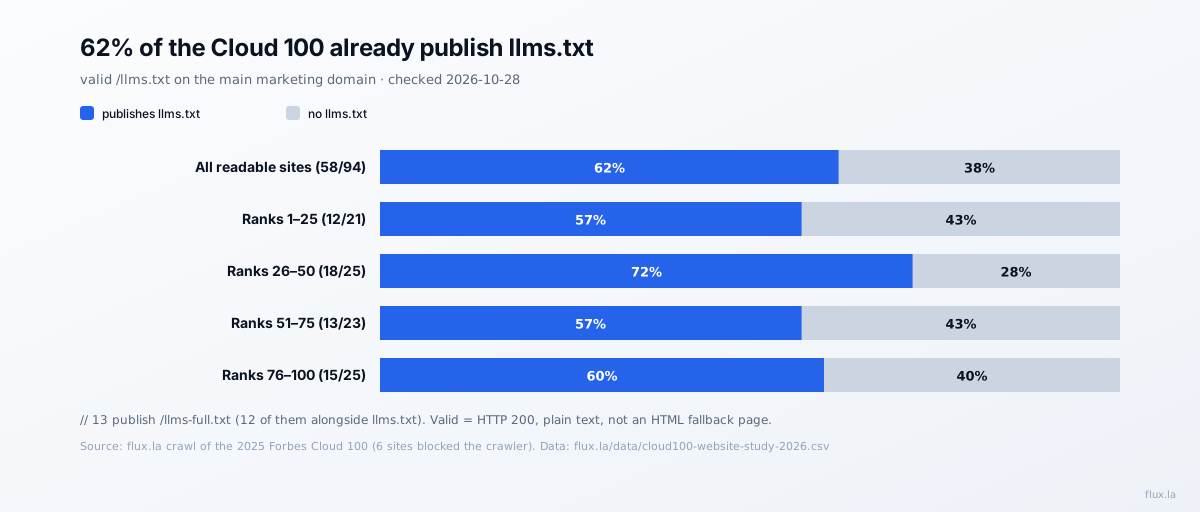
Is llms.txt a fad or a standard? Among the private software companies with the most to gain from AI search, it is already the majority position. We requested /llms.txt from the main domain of every company on the 2025 Forbes Cloud 100 on October 28, 2026. 58 of the 94 sites we could read (62%) serve a valid llms.txt file, and 13 also publish (or only publish) an llms-full.txt.
That is a remarkable number for a format that was only proposed in September 2024 and that Google says it does not need. Below: who has one, what the files actually contain, how closely they follow the spec, and what that means for whether you should bother. The raw data is available as a CSV.
Key findings
- 62% adoption: 58 of 94 readable Cloud 100 marketing sites publish
/llms.txt. Six sites blocked our requests entirely. - No top-of-list effect: adoption is 57% in ranks 1–25, 72% in 26–50, 57% in 51–75 and 60% in 76–100.
- The median file is 12.6 KB with 10 H2 sections and about 66 links. The smallest (Cyera) is 1.6 KB; the largest (Plaid) is 369 KB with 1,476 links.
- Spec conformance is loose. 56 of 58 start with the required H1, 50 include the summary blockquote, and only 18 use the
## Optionalsection the spec defines. - The AI labs keep theirs off the marketing site. Anthropic, Perplexity and OpenAI have no llms.txt on their main marketing domain in our crawl, but each serves one on a developer-docs host.
What llms.txt is, in one paragraph
llms.txt is a Markdown file at the root of a domain that gives language models a curated map of the site. It was proposed by Jeremy Howard on llmstxt.org in September 2024. The spec requires only one thing, an H1 with the site’s name, and recommends a blockquote summary followed by H2 sections of [name](url): note links, with an ## Optional section for links an agent can skip when its context is short. Our llms.txt build guide walks through writing one.
What the Cloud 100’s files actually look like
Having one and having a good one are different things. The 58 files cluster into three shapes:
| Shape | What it looks like | Example from the sample |
|---|---|---|
| Curated map | H1, a one-paragraph blockquote, 5–15 H2 sections of described links | Stripe: product sections with a one-line description per link (70 KB) |
| Full index | Hundreds or thousands of links, often generated from the sitemap or docs tree | Plaid (1,476 links), HiBob (1,967 links), dbt Labs (1,546 links) |
| Off-spec | Bare URLs instead of Markdown links, multiple H1s, or no H1 at all | Arctic Wolf’s file opens with a sentence pointing at its XML sitemap |
The curated map is what the spec describes and what a model with a limited context window can actually use. The full index trades that away for completeness. It is closer to a sitemap in Markdown, and a model reading a 369 KB file is unlikely to treat any single line in it as a priority.
A few details that surprised us:
- Talkdesk opens with
# Purpose: AI usage guidance for Large Language Models (LLMs), then uses several more H1s as section dividers. That is readable to a person but not what the spec’s parser expects. - Cursor titles its file “Cursor Documentation” and lists bare URLs to Markdown versions of its docs rather than
[name](url)links. - Calendly explicitly allows
/llms.txtin robots.txt even for crawlers it otherwise blocks, a neat way to say “read this, not the rest.” We covered that pattern in our Cloud 100 AI-crawler study. - dbt Labs serves an
llms-full.txtof about 9.7 MB, which inlines its documentation. That is a corpus, not a summary.
The AI companies’ own choice
The most telling data point is where the model makers put theirs. On the marketing domains we crawled, Anthropic (www.anthropic.com) and Perplexity (www.perplexity.ai) returned 404 for /llms.txt, and OpenAI’s site blocked our requests. Yet all three serve one on a developer host: platform.claude.com/llms.txt, docs.perplexity.ai/llms.txt and developers.openai.com/llms.txt all returned plain-text files when we checked.
That fits how coding assistants actually use these files: to pull accurate, current API documentation into a session. It is a hint about where llms.txt has proven value today, which is in documentation that people ask agents to write code against.
So should you publish one?
Google’s position is clear. Its guide to AI features in Search says: “You don’t need to create new machine readable files, AI text files, or markup to appear in these features.” llms.txt will not make you rank in AI Overviews.
It is still worth an hour for most B2B companies, for narrower reasons:
- It costs almost nothing. A curated map for a 50-page marketing site is a few kilobytes and an afternoon of thought.
- Agents and coding tools read it. If you have docs, an API or a pricing page that people ask assistants about, a clean index makes the right page easier to find.
- Writing it is a forcing function. Deciding which 30 links describe your company is the same exercise as fixing your internal linking and your site’s information architecture.
- Your peers have one. In the Cloud 100, not having one is now the minority position.
What we would not do is generate a 300 KB dump of every URL and call it done. If the file is not curated, it is a worse sitemap.
If you want the rest of the AI-visibility work done properly (crawler access, citations, measurement), that is what our GEO and AI search service covers, and generative engine optimization explains the strategy behind it.
Methodology
- Sample. The 100 companies on the 2025 Forbes Cloud 100, using each company’s primary website (current domain where Forbes listed an outdated one).
- Fetch. On 2026-10-28 we requested the homepage, followed redirects to the final origin, then requested
/llms.txtand/llms-full.txton that origin with a standard desktop Chrome user-agent. - Validity. A file counts if it returned HTTP 200 and its body was not an HTML page (several sites answer every path with their app shell, which is not an llms.txt).
- Structure. We counted H1 and H2 headings, blockquote lines and Markdown links. A leading byte-order mark, which the spec allows, was stripped first.
- Exclusions and limits. Six sites (OpenAI, Canva, Gusto, Cohesity, Personio and Axonius) blocked or rate-limited our requests, leaving 94. We checked the main marketing origin only, so a company whose llms.txt lives on a docs subdomain counts as “no” here.
FAQ
What percentage of websites have an llms.txt file? Among the 2025 Forbes Cloud 100, 62% (58 of 94 readable sites) published one on their main domain in October 2026. Large private software companies are early adopters, so the share across the wider web is lower.
Does Google use llms.txt? Google says no special files are needed to appear in AI Overviews or AI Mode: “You don’t need to create new machine readable files, AI text files, or markup to appear in these features.” Its value is with agents, coding tools and assistants that fetch it directly.
What should an llms.txt file contain?
At minimum an H1 with your site’s name. Per the spec, follow it with a short blockquote summary and H2 sections of described links to your most important pages, and put secondary links under ## Optional.
What is the difference between llms.txt and llms-full.txt? llms.txt is an index of links. llms-full.txt, a common extension, inlines the content itself so an agent can read it in one request. 13 of the Cloud 100 sites we checked publish one.
Related reading:
- llms.txt explained: the one-hour build guide
- Who blocks AI crawlers?: robots.txt rules of the same 100 companies
- What structured data the Cloud 100 use: JSON-LD on the same homepages
Sources: llmstxt.org; Google Search Central, AI features and your website; Forbes Cloud 100 (2025). Dataset: cloud100-website-study-2026.csv.
One copyable AI agent, every Wednesday.
Flux founder Alejandro Rioja's weekly newsletter for operators: an agent he shipped that week, one growth experiment with real numbers, and what's working across SEO and GEO right now.
Free · 1-click unsubscribe · confirm by email and you're in.
Alejandro Rioja
Operator who builds and sells marketing-focused brands. Founder of Pickleland, founder of Flux.LA, writing about AI SEO + GEO at alejandrorioja.com.