AI Overviews and click-through rate: what the data says in 2026

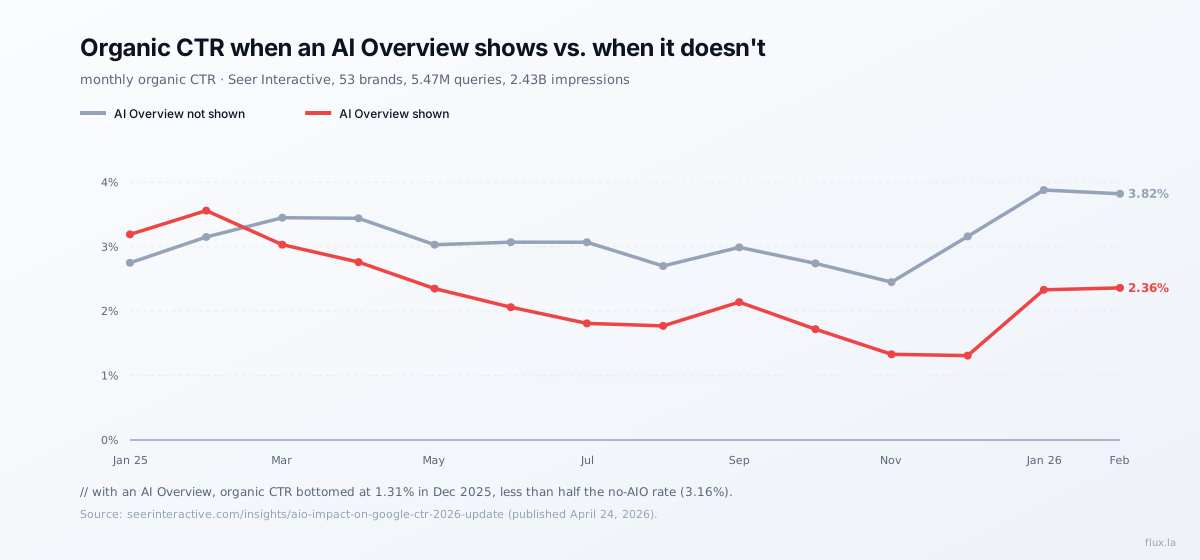
Do AI Overviews reduce clicks? Yes, and every large study now agrees on the direction. The disagreement is only about size. Pew Research found that people clicked a traditional result on 8% of Google visits with an AI summary, against 15% without one. Ahrefs estimates that an AI Overview now correlates with a 58% lower click-through rate for the top-ranking page. Seer Interactive’s 5.5-million-query panel shows organic CTR on Overview queries falling to 1.31% in December 2025, less than half the rate on queries without one.
The more useful finding is buried in the same data: brands cited inside the Overview get roughly twice the clicks of brands that are not. That turns a traffic problem into an optimization target.
The numbers, side by side
| Study | Data | Headline finding |
|---|---|---|
| Pew Research Center | 900 US adults’ browsing, 68,879 Google searches, March 2025 | Traditional-result clicks on 8% of visits with an AI summary vs 15% without. 1% clicked a link inside the summary. |
| Ahrefs (Feb 2026 update) | 300,000 keywords, Dec 2023 vs Dec 2025, aggregated GSC data | Position 1 CTR about 58% lower when an AI Overview is present (was 34.5% in its April 2025 study). |
| Seer Interactive (Apr 2026) | 53 brands, 5.47M queries, 2.43B organic impressions, Jan 2025–Feb 2026 | Organic CTR with an Overview fell from 3.19% to 1.31% (Dec 2025), then recovered to 2.36% (Feb 2026). |
These are different measurements, which is why the percentages differ. Pew measured what real people did on real searches. Ahrefs modeled what the top result would have earned without an Overview. Seer tracked CTR on its clients’ own queries month by month. None is wrong; together they bound the effect.
Where the clicks go, by position
Ahrefs’ update estimates the loss at every one of the top ten positions, and the cost falls hardest on the pages that had the most to lose:
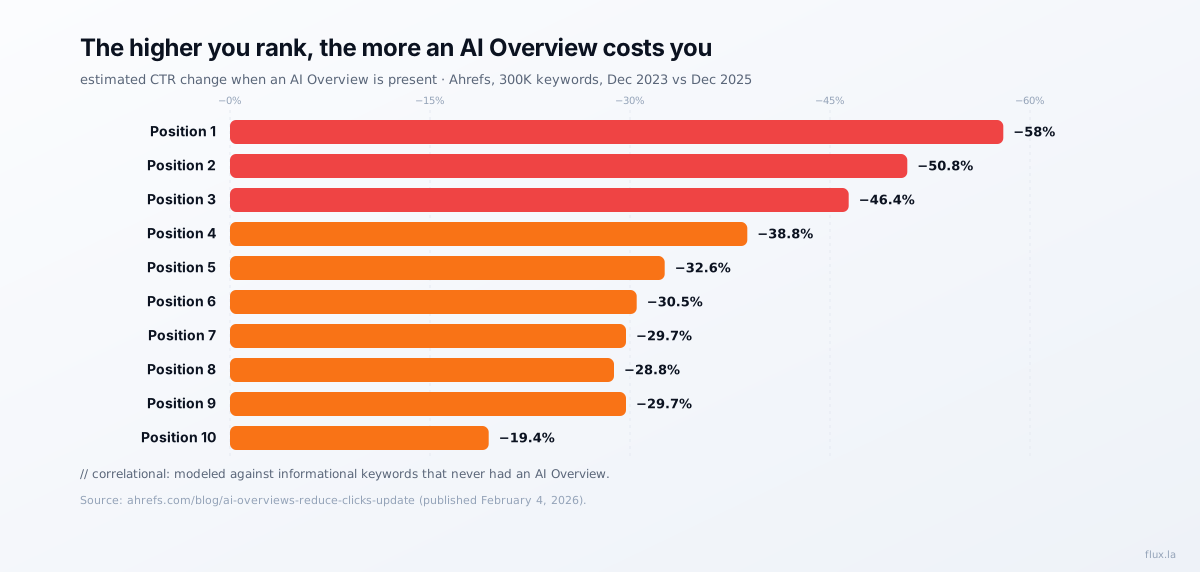
In plain numbers, Ahrefs measured position-1 CTR on Overview keywords falling from 7.3% in December 2023 to 1.6% in December 2025, against a forecast of 3.7% if the Overview had not appeared. Part of the decline is general (informational queries without Overviews also fell, from 7.6% to 3.9%), which is exactly why the study models the difference rather than quoting the raw drop.
Which queries get an AI Overview
Pew found the trigger depends heavily on how a question is phrased:
- 8% of one- or two-word searches produced an AI summary.
- 53% of searches of ten words or more did.
- 60% of searches phrased as questions (who, what, when, why) did.
- Overall, 18% of the March 2025 searches in Pew’s panel produced one.
Seer’s panel, which skews to its clients’ commercial queries, found Overviews on 95.4% of comparison queries, 85.9% of questions, 83.4% of price, cost and buy queries and 81.3% of “best of” queries, against 27.3% of single-word queries. By intent, 36% of informational queries had one, against 8% of commercial and 5% of transactional queries.
That lines up with what we see in our own Search Console: our long, prompt-style queries rank well and draw no clicks.
The part you can control: being cited
Across 2025, Seer found that on informational queries with an Overview, brands cited inside the Overview averaged a 2.07% organic CTR, against 0.94% for brands that were not cited, and 3.35% on queries with no Overview at all. Cited brands also earned a higher paid CTR (15.74% vs 11.19%).
Pew’s data explains why citation matters: only 1% of visits clicked a link inside the summary, but the summary is also where the reader forms a view of which brands are credible. If you are not in it, you are relying on the shrinking share of people who scroll past it.
So the strategy shift is not “SEO is dead.” It is:
- Keep ranking, because Overviews cite pages that already rank and are trusted.
- Get quoted: put a clear, citable answer near the top of each page, with specific numbers and named sources. Our guide to writing posts that AI engines cite covers the structure.
- Measure citations, not only clicks. Clicks undercount your visibility when the answer is on the results page; see zero-click SEO and the AI visibility tracking tools that measure it.
- Win the queries Overviews skip. Pew’s data shows short, navigational and branded searches rarely trigger one. Brand demand is the most Overview-proof traffic you have.
This is the core of generative engine optimization, and of the work in our GEO and AI search service.
A note on recovery
Seer’s data shows Overview-query CTR recovering from 1.31% in December 2025 to 2.36% in February 2026. One or two months is not a trend, and Seer’s own write-up flags that two large accounts shape part of the series. Watch it, but do not plan around it.
FAQ
How much do AI Overviews reduce clicks? Estimates range from about a third to well over half, depending on method. Pew found traditional-result clicks fell from 15% to 8% of visits when an AI summary appeared. Ahrefs estimates position-1 CTR is about 58% lower when an Overview is present.
What share of Google searches show an AI Overview? In Pew’s panel of US users in March 2025, 18% of searches produced an AI summary. The share rises sharply with query length: 53% of searches of ten or more words triggered one.
Do people click the links inside AI Overviews? Rarely. Pew found users clicked a link inside the AI summary on 1% of visits that showed one.
Does being cited in an AI Overview help? Yes. In Seer’s 2025 data, brands cited in the Overview averaged 2.07% organic CTR on informational queries, against 0.94% for brands that were not cited.
Related reading:
- Zero-click SEO: optimizing when the answer is on the results page
- GEO vs SEO: what changes and what does not
- Why AI prompts are showing up in Search Console
Sources: Pew Research Center, July 22, 2025; Ahrefs, AI Overviews reduce clicks by 58% (February 4, 2026); Seer Interactive, AIO impact on Google CTR: 2026 update (April 24, 2026).
One copyable AI agent, every Wednesday.
Flux founder Alejandro Rioja's weekly newsletter for operators: an agent he shipped that week, one growth experiment with real numbers, and what's working across SEO and GEO right now.
Free · 1-click unsubscribe · confirm by email and you're in.
Alejandro Rioja
Operator who builds and sells marketing-focused brands. Founder of Pickleland, founder of Flux.LA, writing about AI SEO + GEO at alejandrorioja.com.