Why ChatGPT-style prompts are showing up in Google Search Console

If your Search Console query report has started to read like a chat log, you are not imagining it. Between May 1 and October 24, 2026, queries of ten words or more produced 1,304 impressions for flux.la: 20% of every impression Google attributed to a query. They ranked at an average position of 7.0, far better than our short queries at 24.2, and they produced zero clicks. Some of them are plainly machine-written: one begins with context: location: united states (not for language). do not include location references in your response. question:.
This post shows what we found in our own data, why it happens, and how to separate these queries from real demand so they stop distorting your reporting.
What the data shows
We split every impression in our Search Console property by the number of words in the query, using regex filters in the Performance report:
| Query length | Impressions | Clicks | Avg. position |
|---|---|---|---|
| 1–4 words | 4,760 | 4 | 24.2 |
| 5–9 words | 475 | 0 | 41.3 |
| 10+ words | 1,304 | 0 | 7.0 |
| Anonymized by Google | 3,855 | 24 | — |
| Total | 10,394 | 28 | 18.9 |
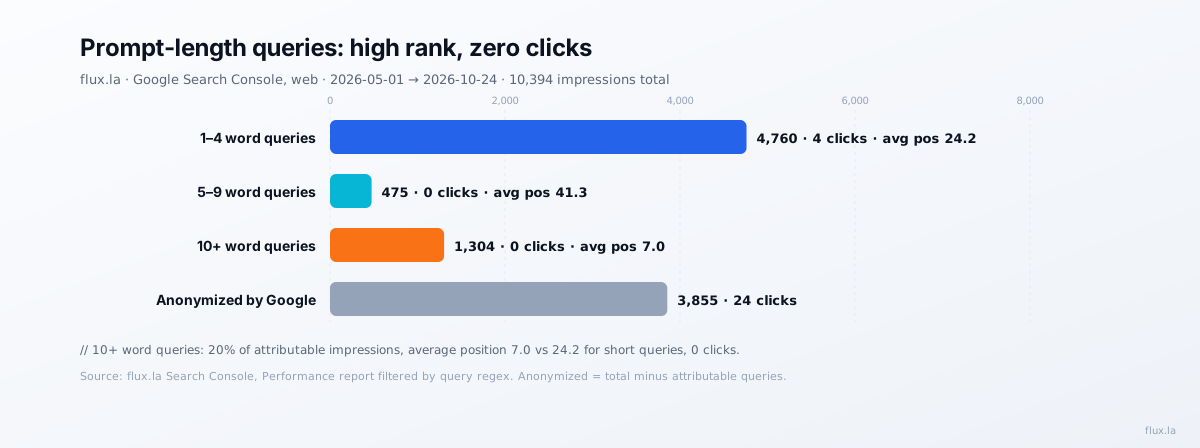
Three things make the 10+ word group stand out. It ranks well, it never gets clicked, and it is concentrated: a single query, “what is the best way to write a blog post to boost ai search visibility and earn citations?”, accounts for 1,179 of the 1,304 impressions, nearly all of them between October 7 and October 21. A second variant, “is it what is the best way to write a blog post…”, added 32 more. Real people do not repeat the same 19-word question, word for word, hundreds of times in two weeks.
Four kinds of prompt-style query
Reading all 31 distinct long queries, they fall into recognisable groups:
- Templated prompts with instructions. The
context: location: united states … question: how do i get my tech article featured in a major publication?query is a system prompt and a question pasted together. Nobody types that into Google by hand. - Persona prompts. One query, at position 4, is a 1,200-character block that begins “i am a 35-44, 45-54, 55-64, or 65+ year old. my job seniority is at the executive level…” and lists a CMO’s motivations and pain points before asking “where do popular platforms fall short on reporting accuracy?” This is the shape of the buyer-persona prompts that AI visibility tools run to simulate a target customer.
- Agentic requests. “our organic rankings are good, but clicks have been declining for months… search online for suitable providers and give me a rundown of specific agencies.” That is an instruction to an assistant, not a search query.
- Natural long questions. “how do you get a startup featured in techcrunch or similar outlets?” or “should i aim to get cited on aggregator blogs to boost llm mentions?” could be people, especially in Google’s AI Mode, where conversational questions are the norm.
Why prompts appear in Search Console at all
Google is explicit that its AI surfaces report into the same place as classic search. Its guide to AI features says sites appearing in AI Overviews and AI Mode “are included in the overall search traffic in Search Console” and are “reported on in the Performance report, within the ‘Web’ search type.” There is no separate AI filter. A conversational question asked in AI Mode, where your page is shown as a source, lands in the same query table as “seo agency near me.”
That explains the natural long questions. The templated and persona prompts point to something else: automated prompt tracking. A growing category of AI-visibility tools sends a fixed list of buyer prompts to AI engines on a schedule to measure which brands get mentioned (we compare them in AI visibility tracking tools). When those prompts run through a Google surface that cites your page, your page earns an impression. The burst pattern fits too: a tracker starts running a prompt set, the impressions climb, and they stop when the project ends or the prompt changes.
We cannot see who sent any individual query, so treat this as the most likely explanation rather than a certainty. But the practical consequence does not depend on who is asking.
Why it matters for your reporting
- It inflates impressions and flattens CTR. On our site, the 10+ word group alone was 12.5% of all impressions in the period and contributed no clicks. A week-over-week chart that includes a burst of these looks like a traffic spike followed by a crash.
- It makes your average position look better than it is. Position 7.0 on 1,304 impressions pulls the site-wide average up. When the burst ended, our average position appeared to “worsen” even though nothing about our real rankings changed.
- It can be useful signal, carefully. The prompts tell you what someone (a competitor, an agency, a buyer) is testing AI engines on. Ours were mostly about getting cited by AI and getting press coverage, which is a fair map of what people expect an agency like us to answer.
This is the same measurement trap we wrote about in B2B attribution and dark social: the numbers are real, but they do not mean what the dashboard implies.
How to filter prompt-style queries out
In Search Console, open Performance → Search results → + Add filter → Query → Custom (regex). Search Console uses RE2 regular expressions.
To exclude queries of ten or more words, choose “Doesn’t match regex” and use:
^(\S+\s+){9,}\S+$To isolate them for a separate report, choose “Matches regex” with the same pattern. For templated prompts specifically, these catch most of what we saw:
(context:|question:|i am a \d|give me a rundown|search online for)We now report three numbers every week: total impressions, impressions excluding 10+ word queries, and clicks (which prompt queries almost never produce). If you track AI search traffic in GA4, compare the trend there rather than relying on Search Console impressions alone.
What to do with the queries you keep
Not every long query is noise. The natural questions are worth answering on the page they land on, because they are exactly how people phrase things in AI Mode and ChatGPT. Our post that drew the 1,179-impression burst was already built for that, following the structure in how to write a blog post for SEO and AI citations. If you want help turning these signals into pages that get cited, that is the work of our GEO and AI search service.
Methodology
- Property and window. flux.la domain property, web search type, 2026-05-01 to 2026-10-24,
data_state: all(includes the most recent, not-yet-final days). - Buckets. Query regex filters in the Search Console API:
^(\S+\s+){0,3}\S+$(1–4 words),^(\S+\s+){4,8}\S+$(5–9 words) and^(\S+\s+){9,}\S+$(10+ words). - Anonymized share. Search Console omits rare queries for privacy. We report the difference between the property total and the three buckets as “anonymized.”
- Limits. One small site. The concentration in a single query means the share would look very different in another window, which is itself the point: these queries arrive in bursts.
FAQ
Why are there long, sentence-like queries in Google Search Console? Google reports AI Overviews and AI Mode in the same Performance report as regular search, so conversational questions where your page appeared as a source show up as queries. Some are typed by people; templated ones with instructions or personas are most likely automated prompt-tracking runs.
Does Search Console show AI Mode traffic separately? No. Google says AI features traffic is included in the overall Web search type, with no separate filter.
How do I filter long queries in Search Console?
Add a Query filter with “Custom (regex)” and “Doesn’t match regex,” using ^(\S+\s+){9,}\S+$ to exclude queries of ten or more words.
Are these impressions bad for my site? No. They do not hurt rankings. They distort reporting: impressions rise without clicks, CTR falls, and average position looks better than it is, until the burst stops.
Related reading:
- AI visibility tracking tools compared: the tools that run prompt sets
- GA4 for GEO: measuring AI search traffic you can trust
- Zero-click SEO: what to optimize when the answer is on the results page
Sources: Google Search Central, AI features and your website; flux.la Google Search Console data, May 1 to October 24, 2026.
One copyable AI agent, every Wednesday.
Flux founder Alejandro Rioja's weekly newsletter for operators: an agent he shipped that week, one growth experiment with real numbers, and what's working across SEO and GEO right now.
Free · 1-click unsubscribe · confirm by email and you're in.
Alejandro Rioja
Operator who builds and sells marketing-focused brands. Founder of Pickleland, founder of Flux.LA, writing about AI SEO + GEO at alejandrorioja.com.